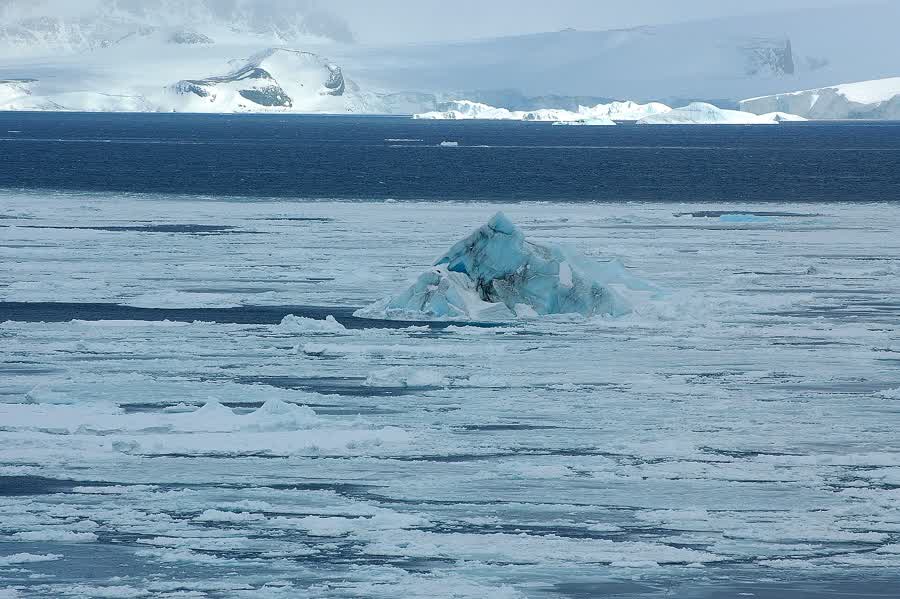
Deep beneath the Southern Ocean, hundreds of metres down, a vast layer of water has quietly changed direction. For decades it was growing fresher. Since about 2016 it has been growing saltier, denser and deeper — and the trigger, according to a new study published in Nature Climate Change, is the abrupt loss of Antarctic sea ice. It is the first direct observational evidence of this change.
1. What is Antarctic Intermediate Water?
Antarctic Intermediate Water, known as AAIW, is a major water mass that forms in the Southern Ocean and spreads northward through the Atlantic, Indian and Pacific oceans, typically hundreds of metres below the surface. It helps store carbon, supply oxygen and drive global ocean currents. As part of the ocean's global overturning circulation, a sustained shift here could, over years to decades, affect the Atlantic overturning current — a possibility the researchers raise, not a measured outcome.
2. How sea ice used to keep it fresh
Each southern winter, sea ice forms across the Southern Ocean, and much of it melts as temperatures rise, releasing freshwater. Until 2016, that summer melt was about triple the Amazon River's entire annual flow of roughly 6,600 cubic kilometres. The freshwater helped maintain a fresh layer of cold water near the surface, which mixed with deeper water and sank to become part of the AAIW. From 1995 to 2015, this steady supply kept the layer freshening.
Mishra and Gayen (Indian Institute of Science) and Alberto Naveira Garabato (University of Southampton) used Argo, a network of around 4,000 robotic floats sampling the upper oceans, plus satellite sea-ice observations. They found AAIW salinity rising by about 0.0048 grams per kilogram per decade around the Southern Ocean, with stronger changes in some regions.
3. What flipped after 2016
From 2016 to 2024 the trend abruptly reversed. Antarctic sea ice shrank to record lows, choking off the seasonal surge: meltwater delivery dropped to roughly double the Amazon's annual flow. With less freshwater entering the system and more warmer, saltier water moving up from the depths, the water feeding into the AAIW became saltier and denser, and the layer sank deeper. A saltier AAIW disrupts how ocean layers are stacked and, per the Indian Institute of Science, lets stored carbon escape more easily.
Gayen put the speed of the change in historical perspective: the last time the AAIW switched was at the end of the last interglacial period, around 130,000 years ago. "That transition took thousands of years, not two decades," he said. His warning that the shift "could be the tipping point for the Atlantic Ocean and the AAIW current" is an assessment of risk, not a confirmed event.
4. The 2026 picture: another low-ice winter
The study's data run to 2024, but 2026 has kept the pattern going. According to the National Snow and Ice Data Center (NSIDC), Antarctic sea ice probably reached its winter maximum on 14 September 2026 at 17.59 million square kilometres — the third-lowest winter maximum in the satellite record, behind 2024 and 2023, the record low. The last four years have produced the lowest four winter maximum extents on record, and the post-peak melt was so rapid that by early October 2026 the ice had reached a new record-low extent for that time of year.
That context needs its own caution. NSIDC notes that the long-term Antarctic trend is not statistically significant: the record since late 1978 has been dominated by year-to-year variability, with surges in 2013 and 2014 followed by a plunge in late 2015. Research scientist Ted Scambos cautions that it is still hard to be sure about global warming and Antarctic sea ice from this record alone.
5. Why a deeper, saltier layer matters
The ocean is the planet's great climate buffer: it absorbs over 90 percent of all heat released into the environment by human activities, mostly stored in the upper ocean, and takes up a large share of human carbon dioxide emissions. If a weakened AAIW layer changes how surface water is carried deeper, it could affect how much carbon the ocean locks away — although, as Gayen stresses, the magnitude and timing are uncertain. Mishra warns that a weakened layer could push more excess heat deeper, meaning existing models may underestimate deep-ocean warming and regional sea-level rise. Those are implications to test, not measurements already made.
Two common questions: does melting sea ice itself raise sea level? No — floating sea ice displaces its own weight, so its melting does not directly raise sea level the way melting land ice does. The concern here is different: the meltwater shortfall is changing the ocean's layered structure, heat storage and carbon storage. And why does saltier water sink? Because it is denser and heavier than fresher water — which is exactly why a saltier AAIW sits deeper.
What to watch next is simple: whether Antarctic sea ice stays low through the southern summer, what the February 2027 minimum brings, and whether Argo floats keep showing the AAIW getting saltier and deeper. For the wider picture, see AstolixGen's learning book Maritime Climate Awareness and our marine pollution guide.
At AstolixGen, a small Karachi-based technology and educational initiative, we follow this research to explain it, not to claim a role in it. We are not a monitoring agency or regulator, and we run no Antarctic programme. Our contribution is education: helping readers understand how the sea actually works, so the next headline about ice, currents or sea level is easier to judge on its evidence.