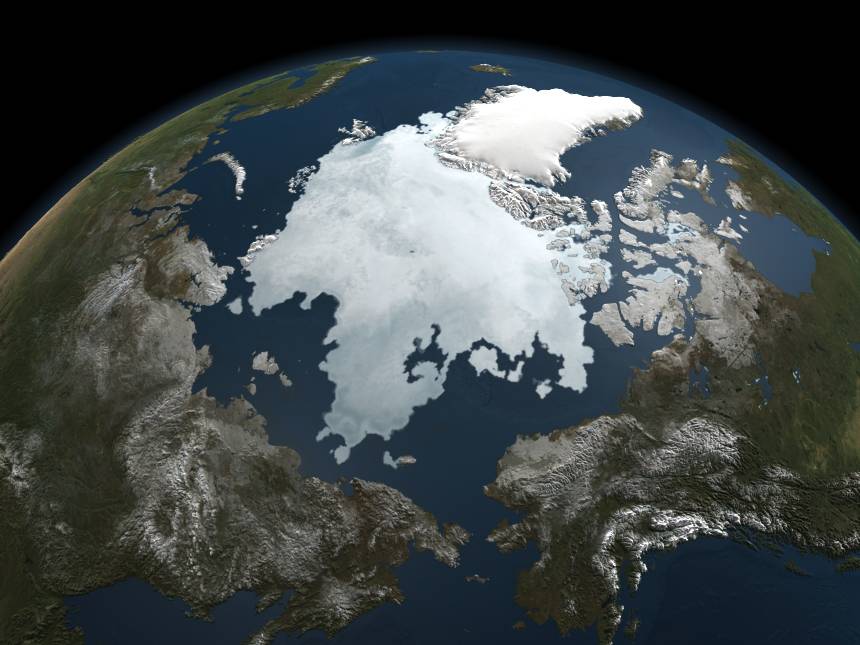
On 12 September 2026, the Arctic Ocean's frozen cover shrank to its smallest extent of the year: 4.60 million square kilometres (1.78 million square miles), according to NASA and the National Snow and Ice Data Center (NSIDC). That ties 2008, 2010 and 2025 for the tenth-lowest minimum in the nearly 48-year satellite record. The tempting headline is that the Arctic is opening up for shipping. The honest one is more useful: less ice does not mean easier sailing, and 2026 is the year the rules for polar shipping got stricter, not looser.
1. What the 2026 minimum actually says
Start with the numbers, because they are easy to misread. The 2026 minimum sits 1.21 million square kilometres above the satellite-era record low of 3.39 million, set on 17 September 2012. But it is also 1.62 million square kilometres below the 1981 to 2010 average minimum — a shortfall NSIDC compares to about the size of Alaska. The long-term trend is still down, at 11.8 percent per decade, and the deeper pattern has not budged: the last 20 years, from 2007 to 2026, are the 20 lowest minimum extents in the satellite record.
There is a genuine puzzle inside those numbers. There has been no significant decline in September minimum extents over the past two decades, and the reasons for that flattening are actively debated. NASA points to one contributor: over the past decade, increased cloud cover has kept sunlight from accelerating the melt. Senior scientist Walt Meier summed it up: “We've plateaued, but we're still low relative to the earlier part of the record.” A plateau at a low level is not a recovery — every year since 2006 has still had a lower minimum than every year from 1979 to 2006.
One more caution: the 2026 figure is preliminary. NSIDC notes that changing winds or late-season melt could still push the extent lower, as happened in 2005 and 2010. NSIDC director Mark Serreze captured the strangeness of this year: “It was only tenth lowest in extent, but despite the fairly cool Arctic Ocean summer, there was loose ice all the way to the pole.” Extent measures area covered, not thickness or strength — and loose, thin, drifting ice is still ice a ship must deal with.
2. Why less ice is not open water
This is the point that matters most for anyone who works at sea. A smaller ice extent on a satellite map does not mean a clear, safe route. The remaining ice is thinner and younger than the thick multi-year ice of earlier decades, it moves with wind and current, and it can close a passage that looked open days earlier. Add polar fog, returning darkness, thinner charts, and rescue days away, and the risk stays serious even in a “good” ice year. The Arctic rewards preparation, not optimism.
3. The rules caught up in 2026
The International Maritime Organization's Polar Code has been mandatory since 1 January 2017, under SOLAS and MARPOL, for ships operating in polar waters. It sets standards for design, equipment, operations, training, search and rescue, and environmental protection that go beyond ordinary global rules, because polar waters add hazards — ice, remoteness, and rapidly changing, severe weather — that normal rules do not cover.
From 1 January 2026, that Code significantly widened its reach. It now covers fishing vessels of 24 metres and above, pleasure yachts of 300 gross tonnage and above not engaged in trade, and cargo ships between 300 and 500 gross tonnage — smaller vessels previously outside the full SOLAS Polar Code rules. New chapters, 9-1 on safety of navigation and 11-1 on voyage planning, require these vessels to carry working navigational and ice-detection equipment, receive up-to-date ice information, and plan voyages accounting for ice conditions, places of refuge, environmental sensitivities and search-and-rescue limits. Ships built on or after 1 January 2026 must comply immediately; older ships have until 1 January 2027.
The timing is the point. As ice retreats, more vessels with less polar experience enter these waters for fishing, cruising, research and niche cargo. If more ships are going north, more of them must plan like polar ships.
4. What this means for a seafarer reading this far from the Arctic
For readers in Karachi, the Arctic feels remote, and this post makes no claim about local ice — there is none to make. The lesson travels anyway: a satellite map, like any single instrument, answers one question and not the next. Extent is not thickness, and an open-looking passage is not a safe one. Trust official forecasts over a single image, and respect advisories — the most dangerous moment is often when conditions look easiest.
5. What to watch next
Three dates are worth marking. First, NSIDC's full analysis of the 2026 melt season, promised for early October, will confirm whether 12 September holds as the minimum. Second, the winter refreeze now under way will show how much thin summer ice survives. Third, 1 January 2027 is the compliance deadline for existing smaller vessels under the expanded Polar Code.
At AstolixGen, a small Karachi-based company, our contribution is awareness and education, not monitoring or regulation. Our Marine Pollution guide explains what happens when oil meets the sea, and our free learning book, Maritime Climate Awareness, explains in plain language what a changing ocean means for seafarers and coastal families. The Arctic's ice is measured every day from space — understanding what those measurements do and do not say is the first step toward respecting them.