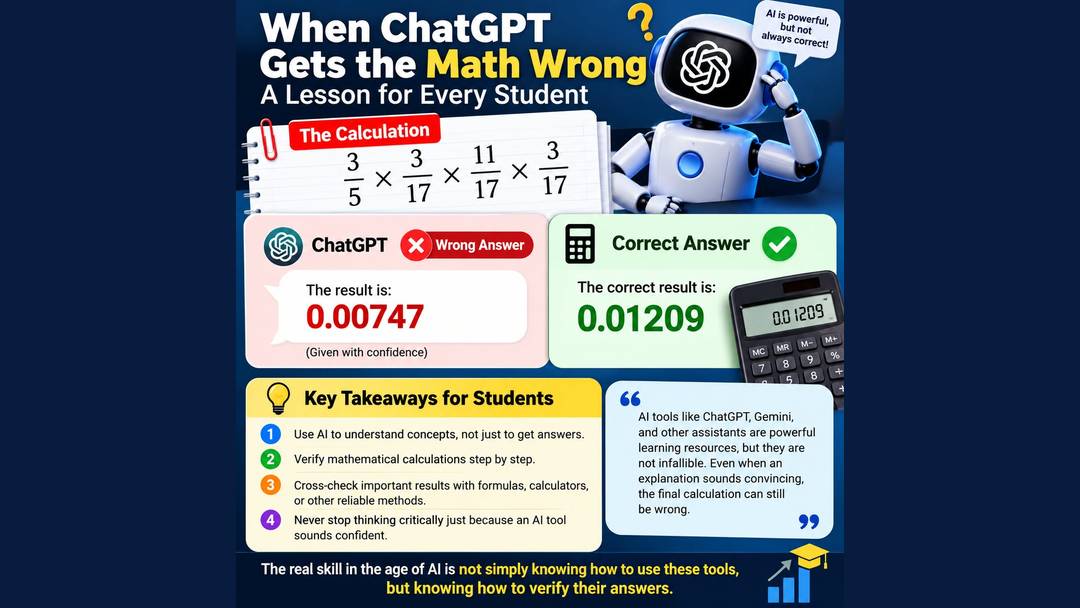
While helping my wife with her MS Artificial Intelligence assignment, we hit a small moment that turned into a big lesson. The question was a Naive Bayes calculation, step-by-step arithmetic a student must show. We asked ChatGPT, and it answered with complete confidence. The answer was wrong.
The calculation was 3/5 × 3/17 × 11/17 × 3/17. ChatGPT first reported 0.00747. When we checked it by hand, the real answer was different: multiply the numerators, 3 × 3 × 11 × 3 = 297; multiply the denominators, 5 × 17 × 17 × 17 = 24,565; divide, and 297/24,565 comes to approximately 0.01209. The chatbot's confident answer was off by about 38 percent — not a rounding difference, a plain arithmetic error. When shown the working, it apologised and corrected itself to 0.01209.
The method was never the problem. The same assignment's binarised version checked out exactly: Score(A) = 2/5 × 2/4 × 2/4 × 3/4 = 0.075, and Score(R) = 3/5 × 3/5 × 4/5 × 2/5 = 0.1152, so the answer is Rejected. The chatbot understood Naive Bayes. It simply multiplied wrong once, and said the wrong result as if it were certain. That is the whole danger in one line: a correct method, a confident tone, and a wrong number.
For a student, the cost of that error depends on where it lands. In an assignment, a copied wrong decimal loses marks. In a borderline case, where two scores are close together, an error of this size can flip the final classification entirely — the model would pick the wrong class, and the student would never know, because the explanation sounded so reasonable.
The same weakness shows up in a second place, and it is the subject of my wife's own research: references. AI tools can produce citations that look perfect — real author names, real journal titles, plausible years — and yet point to papers that do not exist. Her coursework examined a 2025 study of DOI fabrication in AI-generated citations, and the lesson matched our arithmetic story exactly: the output looks scholarly, the formatting is flawless, and only a check against a real index, such as Crossref, reveals whether the reference is real. A confident citation is not a verified citation, just as a confident decimal is not a verified decimal.
Why does this happen? In plain terms, a chatbot writes what sounds most plausible next; it does not automatically run a calculator or check a database unless it is set up to do so. Its confidence is a matter of writing style, not a measure of correctness. That is not a reason to stop using AI — it is a reason to change how we use it. The tool explains a method well, but it is unreliable as the final judge of its own arithmetic or references.
For students, four habits cover almost everything. First, recompute every number yourself, with a calculator or by hand, before you submit it. Second, check the steps, not just the final answer — the steps were where the correction lived. Third, verify every reference an AI gives you: search the title, check the DOI, and open the paper before you cite it. Fourth, ask the chatbot to show its working, and then check that working instead of trusting the summary. These habits take minutes, and they are the difference between using AI and being used by it.
Teachers can help by grading the same way. An assignment that only asks for a final number invites copying; one that asks for working, sources, and one line saying what was checked and how, teaches the skill students will actually need. A short viva — a face-to-face oral exam where the teacher asks the student to explain their own work — catches in seconds what a plagiarism checker never will. For this assignment, viva questions could be: 'Show me how you got 24,565 in the denominator.' 'Why did you multiply these four fractions, and what does each one mean?' 'How did you verify 0.01209, and what would you do if the chatbot disagreed?' A student who did the work answers easily; a student who only copied cannot. Teaching verification is slower, and it lasts.
Where does AstolixGen fit into this, honestly? We are a Karachi-based technology company; our AI, automation and IoT work is at pilot-design stage, not deployed systems. The lesson from this assignment shapes how we build: any AI output in a tool we make must carry its own verification layer — show the working, show the source, let the user check it. A dashboard nobody can audit is not a trustworthy tool, however modern it looks.
The honest caveat is that AI remains a very good tutor. It explained the Naive Bayes method clearly, it corrected itself when challenged with working, and it is patient at midnight in a way no textbook is. The point of this story is not to fear the tool or to ban it. It is that the real skill in the age of AI is not knowing how to ask the chatbot a question. It is knowing how to check the answer it gives you — and never handing that job over entirely, no matter how confident it sounds.
Sources: Author's own verified calculation (297/24,565 ≈ 0.01209) and binarised Naive Bayes scores (0.075 and 0.1152) from an MS Artificial Intelligence assignment, October 2026; 2025 study of DOI fabrication in large-language-model-generated citations, examined in related MS coursework.