← All 50 books
Book 50 of 50 · Free
AI Career Paths in 2026
26,518 words · 17 chapters · illustrated
Book 50 of 50 · Free
26,518 words · 17 chapters · illustrated
Book 50 of 50 — AstolixGen Learning Series (Detailed Edition)
For researcher and publication students
This book is a practical guide to building a career in artificial intelligence in 2026, written for students and early researchers who already know the mathematics and the code but do not yet know how the job market actually works. It maps the real roles that exist today, the skills employers test in interviews, the difference between what a degree signals and what skills prove, and the paths available beyond the standard "get a job at a big company" script — including freelancing, research careers, hybrid roles, and remote work. Every chapter connects career thinking back to your research life, because for a researcher the strongest career asset is the ability to turn papers and projects into proof of capability. By the end, you will have a personal five-year plan, a realistic view of salaries and negotiation, and a clear sense of which doors your background can open and how to walk through them.
What you will learn:
| Chapter | Guiding Question | Key Takeaway |
|---|---|---|
| 1. The AI Job Market in 2026: An Honest Map | What does the AI job market actually look like right now? | Demand is real but uneven; applied skills and proven delivery beat hype. |
| 2. Role Map: ML Engineer, Data Scientist, AI Researcher, and More | Which AI roles exist, and how do they differ? | Titles hide different daily work; match the role to what you enjoy doing. |
| 3. Skills Employers Actually Test | What do interviews really measure? | Fundamentals, coding fluency, ML depth, and communication — in that layered order. |
| 4. Degrees vs Skills: What Really Matters | Do I need a PhD to work in AI? | It depends on the role; portfolios and proof of work close most gaps. |
| 5. Breaking In: Internships and First Roles | How do I get my first AI job? | Structured projects, open source, and targeted applications beat mass applying. |
| 6. Freelancing and Consulting in AI | Can I work for myself in AI? | Yes — if you sell outcomes, scope tightly, and manage the business side. |
| 7. Research Careers: Academia and Industry Labs | Should I pursue research as a career? | Both paths reward publishing; they differ in freedom, funding, and pace. |
| 8. Hybrid Roles: AI Product Management and Beyond | What if I want to mix technical and non-technical work? | Hybrid roles exist and pay well, but they require credibility in both worlds. |
| 9. Interview Preparation: Technical and Behavioral | How do I prepare systematically? | Rehearse the same small set of stories, code patterns, and concepts until fluent. |
| 10. Salary Negotiation and Growing Your Career | How do I get paid fairly and keep advancing? | Negotiate with information and alternatives; growth comes from visible impact. |
| 11. Working Remotely in AI: Making It Work | Can I build an AI career remotely? | Yes, with deliberate communication habits and visible output. |
| 12. Your Five-Year Career Plan | What is my concrete next step? | A written plan with quarterly milestones beats vague ambition. |
| Role | Core Skills | Who It Suits |
|---|---|---|
| Machine Learning Engineer | Python, PyTorch/TensorFlow, software engineering, model deployment | Builders who like shipping working systems |
| Data Scientist | Statistics, SQL, experimentation, storytelling with data | Analysts who enjoy business questions and stakeholders |
| AI Research Scientist | Deep theory, paper reading/writing, novel methods, math | Curious minds who love open-ended problems (often PhD) |
| Research Engineer | ML depth plus strong engineering, reimplementation | People who bridge papers and production |
| Data Engineer | SQL, pipelines, distributed systems, data modeling | Systems thinkers who like reliable infrastructure |
| MLOps / ML Platform Engineer | Docker, Kubernetes, CI/CD, monitoring, cloud | Engineers who enjoy automation and reliability |
| LLM / GenAI Application Engineer | APIs, prompt design, RAG, evaluation, full-stack basics | Fast-moving builders who ship user-facing AI features |
| AI Product Manager | Technical literacy, user research, roadmapping, metrics | Technical people who enjoy decisions and customers |
| AI Consultant / Freelancer | Scoping, delivery, client communication, one strong niche | Self-directed workers comfortable with uncertainty |
| Book Part | How It Helps Your Research Thinking |
|---|---|
| Chapters 1–2 (market and roles) | Teaches you to position your thesis topic against real demand, so your research stays relevant. |
| Chapters 3–4 (skills and degrees) | Shows which skills to build alongside your degree so graduation is not a cliff edge. |
| Chapters 5–6 (breaking in, freelancing) | Turns your research artifacts — code, datasets, papers — into job-market proof. |
| Chapter 7 (research careers) | Directly maps your publication record to academic and industry-lab hiring criteria. |
| Chapters 8–9 (hybrid roles, interviews) | Trains you to explain your research to non-specialists, a skill interviews and grants both reward. |
| Chapters 10–12 (negotiation, remote, planning) | Gives your research career a business backbone: pay, sustainability, and direction. |
Every few months, a headline declares that AI is either hiring everyone or replacing everyone. Neither story is useful when you are planning your own career. The honest picture is more complicated and more encouraging: the AI job market in 2026 is large, real, and uneven. Some corners are crowded with applicants, some are quietly desperate for talent, and the difference between them is the difference between knowing buzzwords and being able to deliver working systems.
Let us start with what changed. The arrival of capable large language models shifted a large share of AI work from "train a model from scratch" to "build useful things with existing models." This created an entirely new layer of jobs — application engineers who connect models to products, evaluation specialists who measure whether those products work, and domain experts who adapt generic AI to medicine, law, agriculture, and education. At the same time, the older layers did not disappear: someone still has to train models, manage data, build infrastructure, and do the research that produces the next generation of techniques.
The result is a market with two broad halves. The first half is the model layer: research scientists, ML engineers, and infrastructure specialists working at AI labs, cloud providers, and well-funded startups. These roles are prestigious, highly paid, and genuinely competitive — there are far more applicants than seats, and the bar is high. The second half is the application layer: companies in every industry that need AI built into their products and operations. This half is much larger in headcount, less visible in the press, and often more accessible to a strong master's student or a self-taught engineer with a good portfolio. A hospital network needs someone to build a triage assistant; a logistics company needs demand forecasting; a government agency needs document processing. These employers do not care about your citation count. They care whether you can take a messy problem, build something that works, and keep it working.
There is also a third, smaller segment worth knowing about: the evaluation, safety, and governance layer. As AI systems moved into regulated and high-stakes settings, demand grew for people who can test models for bias, robustness, and compliance, write evaluations, and translate between technical teams and regulators. This segment suits researchers with a careful, critical mindset and is less saturated than the headline roles.
Now the honest warnings. First, the junior market is crowded. Thousands of graduates emerge each year with similar coursework, similar certificates, and similar tutorial projects. If your resume looks like everyone else's, you will compete on volume, and volume is a losing game. Differentiation comes from proof of independent work: a project you designed yourself, an open-source contribution, a paper, a deployed application with real users. Second, hype titles mislead. "Prompt engineer" as a standalone career largely evaporated into a skill every AI engineer is expected to have. Chasing whatever title is fashionable this quarter is a poor strategy; building durable fundamentals is a good one. Third, geography matters. Salaries and opportunity concentrate in certain cities and countries, but remote work has genuinely widened access — more on that in Chapter 11.
Consider a realistic scenario. Sara is finishing her MS in computer science in Karachi. She has good grades, one workshop paper, and three coursework projects. She applies to fifty "AI engineer" postings and hears nothing. The problem is not her ability; it is that her applications are indistinguishable from thousands of others. She changes strategy: she picks one real problem — Urdu-language document search for a local NGO — builds a working retrieval system, writes up the engineering decisions, and puts the demo and code online. She now has one story no one else can tell. Within two months she has three interviews, because hiring managers could see what she can do before they ever spoke to her. This is the pattern that works: stop broadcasting credentials, start demonstrating capability.
Another scenario: David has a PhD in machine learning with four published papers. He assumes industry research labs will compete for him. Some will — but he discovers that many applied roles view his profile as overqualified and under-experienced in engineering. He spends three months building software engineering fluency — version control discipline, testing, code review, deploying a model behind an API — and suddenly his research depth becomes an asset instead of a question mark. The lesson cuts both ways: credentials open doors, but the ability to ship walks through them.
A third scenario: Ahmed works in IT support and wants to move into AI without quitting his job. He cannot afford a full-time degree. He spends a year on a structured self-study path — Python, statistics, machine learning fundamentals — and builds two projects related to his current work: a ticket-classification tool and a small forecasting dashboard. His own employer becomes his first AI client. This path is slower but real, and it is how a large fraction of working professionals actually transition.
For your research: Treat the job market as a research problem. Pick ten job postings for roles you want, extract the required skills into a table, and count frequencies. This is a literature review of employer demand. Repeat it every six months and watch which skills rise and fall. Use the result to choose your next project or paper topic: the overlap between "what employers need" and "what interests you" is where your thesis becomes a career asset.
Job postings are noisy data, and learning to read them critically is a career skill in itself. Start with red flags. Be cautious of postings that list every technology invented in the last decade — they signal a team that does not know what it needs. Vague phrases like "rockstar," "ninja," or "wear many hats" often mean undefined expectations and long hours. Postings that demand a take-home project of more than a few hours before any human conversation are asking for free labor; a reasonable assignment respects your time. And any role that cannot describe what success looks like in the first six months will be hard to succeed in, because no one will know either.
Green flags are the mirror image: a posting that describes a specific problem ("reduce false positives in our fraud pipeline"), names the team you would join, lists a realistic stack, and mentions mentorship or growth. Companies that publish engineering blogs or open-source code are showing you their culture before you apply — read those artifacts the way you would read a paper's methodology section.
Pay attention to sector patterns. In 2026, AI hiring is not evenly spread across industries. Healthcare, financial services, logistics, and government-adjacent work consistently need applied AI talent and tend to offer stability; early-stage startups offer learning speed and risk. Neither is universally better — the right choice depends on your risk tolerance and what you want to learn. Contract roles deserve a clear-eyed look too: they pay well and build experience fast, but they rarely include mentorship or job security. A six-month contract at a good team can be an excellent bridge into a permanent role; a string of short contracts with no learning is just churn.
Finally, track the market the way you track a research field: longitudinally. Save interesting postings, note which skills appear repeatedly, and revisit your notes every few months. You will start to see real trends — which specializations are heating up, which tools are becoming standard, which industries are hiring. This habit takes thirty minutes a month and compounds into genuine market intuition, the kind that lets you position yourself ahead of demand instead of chasing it.
"AI jobs" cluster in specific sectors, and each has a distinct character. Healthcare needs AI for medical imaging, clinical documentation, triage, and operations — the work is mission-driven and stable, but regulated, slow-moving, and demanding about validation. Finance hires for fraud detection, risk modeling, algorithmic trading, and customer service automation — well-paid and data-rich, but secretive and compliance-heavy. Retail, e-commerce, and logistics need recommendations, demand forecasting, route optimization, and warehouse automation — practical, measurable work where your models visibly move business numbers. The public sector and NGOs need document processing, citizen services, and resource planning — often lower-paid but meaningful, and increasingly open to remote contractors. Education technology needs tutoring systems, assessment tools, and content generation — a sector where your work reaches learners directly.
Startups versus established companies is the other great divide. Startups offer steep learning curves, broad responsibility, and speed — you might own a whole system in month two. They also offer chaos, shifting priorities, and real failure risk. Established companies offer mentorship, process, and stability, but sometimes narrow roles and slower movement. Early in your career, optimize for learning and mentorship over prestige or pay: the skills you build in years one through three compound for decades.
Before joining any employer, assess their AI maturity with five questions. One: does the team own a real problem with measurable outcomes, or is this an "AI exploration" with no success criteria? Two: what data exists, and who controls it — the number one killer of AI projects is data that turns out to be inaccessible or unusable. Three: who will maintain what you build — a team with MLOps practices, or you alone forever? Four: how does the organization make decisions about models — is there evaluation discipline, or does the loudest voice win? Five: what happened to the last AI project — shipped and maintained, or abandoned? You can ask versions of these in interviews; the answers tell you whether you are joining a team that will grow your career or a mess that will consume it.
AI skills decay faster than in most fields, and planning around that fact separates durable careers from fragile ones. Think in two buckets. Perishable skills — specific frameworks, prompt tricks, this year's hot architecture — have a half-life of one to three years. They are necessary for getting hired today but worthless as a long-term moat. Durable skills — mathematical reasoning, software engineering discipline, experimental design, data intuition, clear writing, the ability to learn new tools quickly — compound for decades. The winning allocation is to rent the perishable and own the durable: learn each new tool fast enough to be employable, but invest your deep practice hours in fundamentals that survive every hype cycle.
Build a learning system, not just learning goals. A sustainable rhythm: ninety minutes a week reading papers or technical writing in your area, one small experiment or build per month that forces you to touch something new, and one public artifact per quarter — a blog post, a talk, an open-source contribution — that converts learning into reputation. Tie learning to your actual work wherever possible: the engineer who learns a new evaluation method by applying it to their team's model learns ten times faster than one who reads about it abstractly.
Watch for the two failure modes. The first is chasing novelty — rebuilding your stack every six months, forever a beginner. The second is fossilization — mastering one stack in 2023 and defending it against all evidence. The healthy middle: a stable core of fundamentals, a rotating edge of current tools, and the honest habit of asking, twice a year, "what am I avoiding learning, and why?" The answer to that question is usually your next career unlock.
Key takeaways:
Job titles in AI are notoriously slippery. Two companies can advertise "Machine Learning Engineer" and mean entirely different jobs — one wants a researcher who trains models, the other wants a backend developer who calls an API. Before you choose a path, you need a map of what people in each role actually do all day. This chapter draws that map.
Machine Learning Engineer. The core builder role. An ML engineer takes a problem, selects or trains a model, and puts it into production where real users or systems depend on it. Daily work mixes data wrangling, training and tuning, writing production code, and monitoring models after deployment. The defining trait is ownership of the full loop from data to deployed system. This role suits people who like making things work in the real world and who are comfortable with both research papers and software engineering discipline.
Data Scientist. The question-answerer. Data scientists work with stakeholders — product managers, executives, clinicians — to turn business questions into analyses, experiments, and models. The toolkit leans toward statistics, SQL, visualization, and experimental design rather than deep learning. A data scientist might spend a week figuring out why a metric dropped, design an A/B test, and present findings to leadership. This role suits people who enjoy ambiguity, communication, and the moment an analysis changes a decision.
AI Research Scientist. The inventor. Research scientists push the boundary of what models can do: new architectures, new training methods, new theoretical understanding. The output is papers, and the daily work is reading, hypothesizing, experimenting, and writing. This role almost always requires a PhD or equivalent research record, and it concentrates in AI labs, universities, and research divisions of large companies. It suits people who are driven by open questions and comfortable with long periods of uncertain payoff.
Research Engineer. The bridge. Research engineers sit between research and production: they reimplement papers, scale up promising ideas, and turn prototypes into reliable systems. They need both ML depth and serious engineering skill. If you love reading papers but also love shipping code, this is often the happiest middle ground — and it is a role where a strong master's student with excellent engineering can compete with PhDs.
Data Engineer. The foundation layer. Data engineers build the pipelines that move data from sources into usable stores: ingestion, cleaning, transformation, warehousing. Without them, nothing else works — models train on stale or broken data, dashboards lie. The work is systems-heavy: SQL, distributed processing, orchestration tools, data modeling. It suits people who like building reliable infrastructure and who find satisfaction in systems that quietly never break.
MLOps / ML Platform Engineer. The reliability layer for models specifically. When a company has dozens of models in production, someone must manage deployment pipelines, versioning, monitoring for drift, and rollback procedures. MLOps engineers combine DevOps skills with ML awareness. This is one of the least glamorous and most employable specializations: every serious AI team needs it, and relatively few candidates pursue it.
LLM / Generative AI Application Engineer. The newest large role. These engineers build products on top of foundation models: retrieval-augmented generation systems, agents, copilots, and internal tools. The work is fast-moving and product-oriented: prompt design, evaluation harnesses, orchestration frameworks, API integration, and full-stack development. It suits builders who thrive on shipping quickly and learning new tooling every quarter. The caution from Chapter 1 applies: the durable version of this role is "engineer who builds reliable AI applications," not "person who writes prompts."
AI Product Manager. The decision-maker (covered in depth in Chapter 8). PMs define what gets built, for whom, and how success is measured. In AI, this requires enough technical literacy to judge feasibility and enough product sense to find real user value.
AI Consultant / Freelancer. The hired gun (Chapter 6). Consultants parachute into organizations, scope AI projects, deliver working systems or strategies, and leave. This suits self-directed people with one strong niche and good communication skills.
Consider how the same person might fit different roles. Layla has a master's in statistics, writes clean Python, and loves explaining her findings to non-technical audiences. She would be a strong data scientist, a mediocre research scientist (she dislikes open-ended theory), and a fine ML engineer if she invested in engineering skills. Her best move is to lean into her strengths — experimentation, communication, stakeholder work — rather than chase the most prestigious title. Contrast with Omar, who spends weekends reimplementing papers in PyTorch and dreams about training dynamics. He is a natural research engineer, and his path runs through deep technical projects, not stakeholder presentations.
A realistic scenario: a mid-size e-commerce company posts for a "data scientist." The actual job: build and maintain a recommendation system, which is ML engineering plus some analysis. Candidates who prepared only for statistics interviews fail the coding rounds; candidates who only prepared LeetCode fail the product-sense questions. The lesson: read the job description for verbs, not titles. Verbs like "design experiments" signal data science; verbs like "deploy," "scale," and "maintain" signal engineering.
Another scenario: a fresh graduate insists on "AI researcher" roles and ignores everything else. After six months of rejections, a mentor points out that "applied scientist" and "research engineer" postings at the same companies ask for nearly identical qualifications with half the competition. She broadens her search and lands a research engineer role, where she publishes within her first year. Titles are marketing; the work is what matters.
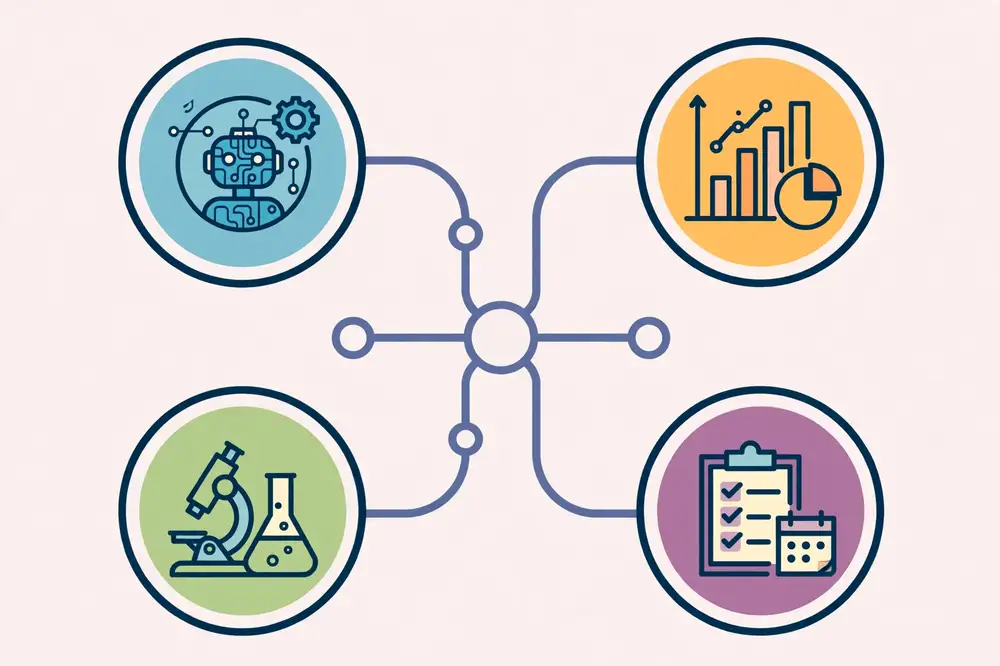
For your research: Map your thesis onto two or three roles from this chapter. For each, write one paragraph explaining how your research demonstrates the role's core skill — for example, how your data pipeline work maps to data engineering, or how your ablation studies map to experimental rigor. This becomes the "relevant experience" section of your resume and the backbone of your interview stories.
Titles make more sense when you see the daily texture. A machine learning engineer's Tuesday might look like this: morning standup, then debugging why a model's offline metrics do not match production behavior — it turns out a feature pipeline changed upstream. Afternoon: retraining with corrected data, writing a unit test for the preprocessing step that caused the issue, and reviewing a teammate's pull request. An AI research scientist's Tuesday: reading two new papers over coffee, a whiteboard session arguing about why an experiment failed, launching three training runs, and drafting a rebuttal for a conference review. A data scientist's Tuesday: a stakeholder meeting to clarify what "improve retention" means in measurable terms, an afternoon of SQL and cohort analysis, and a slide deck translating findings into a recommendation. None of these days is glamorous; all of them are satisfying to the right person. When choosing, imagine the Tuesday, not the title.
It also helps to see how the roles collaborate on one team. Picture a company building a fraud-detection product. Data engineers build the transaction pipelines. Data scientists analyze fraud patterns and define what "suspicious" means. ML engineers train and deploy the detection model. MLOps engineers keep it running, monitor drift, and manage retraining. The PM decides which fraud types to prioritize and how aggressively to block transactions. A research scientist might prototype a novel graph-based approach on the side. Everyone's work touches everyone else's — which is why the most valued team members are not just deep in their specialty but literate in their neighbors' work. An ML engineer who understands data engineering constraints, or a PM who understands model limitations, is dramatically more effective.
Switching lanes between roles is normal and often strategic. Common moves: data scientist to ML engineer (by building engineering depth), ML engineer to research engineer (by going deeper into papers and methods), software engineer to MLOps (a natural adjacent step), and researcher to PM or DevRel (trading depth for breadth and influence). Each switch takes six to eighteen months of deliberate preparation and is easiest inside a company that already knows your work — internal transfers are the lowest-risk lane changes in any career. When planning a switch, identify the two or three credibility gaps (for example, a data scientist moving to ML engineering needs production coding and deployment experience) and close them with visible projects before you apply.
If the role map feels overwhelming, use this framework. Answer five questions honestly. One: do you prefer open-ended questions or well-defined problems? Open-ended points toward research; well-defined toward engineering and data science. Two: do you get energy from people or from deep solo work? People-energy suits data science, PM, consulting, and DevRel; solo-depth suits research and much of engineering. Three: what does a satisfying week look like — shipping something users touch, publishing a result, or answering a question that changes a decision? Four: how do you feel about ambiguity in evaluation — is your work "done" when the tests pass, when the paper is accepted, or when the stakeholder is convinced? Five: which of your past projects did you enjoy most, and what were you actually doing hour by hour? Your revealed preferences — what you do when nobody assigns it — are more trustworthy than your aspirations.
Then run a ninety-day experiment instead of making a permanent decision. Pick the leading role and spend three months doing its work in miniature: for ML engineering, build and deploy a small service; for data science, take a public dataset and produce a stakeholder-style analysis with recommendations; for research, reproduce a paper and extend it slightly. Ninety days of real work teaches you more about fit than a year of deliberation. Most people discover their answer in the doing — the role whose frustrations feel worth tolerating is usually the right one.
Finally, learn the entry-level titles to search for each lane, because "junior AI researcher" rarely exists. ML engineering: "ML engineer," "applied ML engineer," "software engineer (ML)." Data science: "data scientist," "analytics engineer," "product analyst." Research: "research engineer," "applied scientist," "research assistant." Data engineering: "data engineer," "analytics engineer." MLOps: "MLOps engineer," "ML platform engineer," "DevOps (ML)." LLM applications: "GenAI engineer," "LLM engineer," "AI application developer." Searching the right titles doubles the relevant postings you find — another small mechanical advantage that compounds.
Every AI role has an implicit ladder — junior, mid-level, senior, staff or principal — and understanding what changes between rungs helps you aim your growth. At the junior level, you are given well-defined tasks and judged on execution quality and learning speed. The most common junior mistake is waiting to be told exactly what to do; the juniors who stand out ask good questions, finish tasks completely (including tests and documentation), and steadily expand what they can do unsupervised.
At mid-level, you own problems, not just tasks: given an ambiguous goal, you figure out the approach, execute it, and handle the surprises. The shift is from "doing what you're told well" to "deciding what should be done." At senior level, you own outcomes across projects: you set technical direction, unblock others, and are accountable for results that span quarters. Your leverage comes through other people — mentoring, reviewing, designing systems others build on. At staff and principal levels, you operate across teams or the whole organization: identifying the important problems, setting standards, and influencing without formal authority. The further up the ladder, the more the job becomes judgment, communication, and taste rather than raw output.
Two implications for your planning. First, the skills that get you hired (coding, modeling) are not the skills that get you promoted (ownership, communication, judgment) — start building the second set early. Second, titles inflate differently across companies: a "senior" at a ten-person startup and a "senior" at a large lab are different jobs. When evaluating offers or planning moves, compare scope and expectations, not just titles. Ask in interviews: "what does someone need to demonstrate to reach the next level here?" The clarity of the answer tells you how seriously the company takes growth — including yours.
Key takeaways:
Employers do not hire "knowledge of AI." They hire specific, testable abilities, and interviews are designed to probe them. This chapter breaks down the skill stack employers actually test, layer by layer, with the kinds of questions each layer produces.
Layer 1: Programming fluency. Almost every AI role requires writing code under time pressure. The standard is Python: data structures, algorithms, and the ability to write clean, working code in an interview setting. You do not need to be a competitive programmer, but you need to be fluent — the way a driver is fluent with a car, not the way a tourist reads a map. Typical questions: reverse a linked list, find duplicates in an array, implement a simple cache. The hidden test is not just correctness but clarity: can you explain your approach, handle edge cases, and write code someone else could maintain?
Layer 2: Mathematical and statistical foundations. Linear algebra (vectors, matrices, eigenvalues), probability (distributions, Bayes' theorem, expectation), calculus (gradients, chain rule), and statistics (hypothesis testing, confidence intervals, regression). Interviews test these conceptually rather than computationally: "Why does gradient descent converge?" "What does a p-value actually mean?" "When would you use precision versus recall?" Researchers often overestimate how much of this they can articulate under pressure — knowing it for an exam and explaining it to an interviewer are different skills.
Layer 3: Machine learning core. This is the heart of most technical interviews: supervised vs. unsupervised learning, bias-variance tradeoff, overfitting and regularization, cross-validation, ensemble methods, and the ability to design an end-to-end modeling approach for a realistic problem. The classic interview format is the case-style ML design question: "Design a system to detect fraudulent transactions." There is no single right answer; interviewers watch how you structure the problem — data, features, baselines, metrics, iteration, deployment concerns. Start simple, justify choices, and discuss tradeoffs out loud.
Layer 4: Deep learning depth. For roles that involve neural networks: how backpropagation works, what activation functions do, why normalization helps, the intuition behind attention, and hands-on experience with a framework like PyTorch. Interviewers probe for genuine understanding versus tutorial-level familiarity. "Explain what happens during one training step of a transformer" separates people who have trained models from people who have watched videos about training models.
Layer 5: Data and engineering skills. SQL fluency, data cleaning judgment, version control, testing, and basic system design. Many strong ML candidates fail here — they can derive backprop but cannot write a JOIN or design a data pipeline. For applied roles, this layer is often the actual differentiator.
Layer 6: Applied AI skills. Working with LLM APIs, retrieval-augmented generation, evaluation design, prompt structuring, and cost/latency tradeoffs. This layer changes fastest, so interviewers test judgment more than specific tools: "How would you evaluate whether your RAG system is actually good?" is a better question than "Which vector database do you use?"
Layer 7: Communication. Explaining technical work to non-technical stakeholders, writing clearly, and presenting tradeoffs. This is tested in every behavioral round and in the way you answer technical questions. The candidate who says "I chose this approach because the business needed an answer in two weeks, so I traded some accuracy for speed" beats the candidate who recites the most sophisticated method.
Sample interview questions by area, with what they really test:
A realistic scenario: Hassan is strong in theory — he can explain transformers beautifully. But in interviews he freezes on medium coding problems and cannot write SQL joins. He spends six weeks doing one coding problem and one SQL exercise daily, and his interview pass rate triples. Theory got him the interviews; fluency got him the offers. The lesson: prepare the layers you are weakest in, not the ones you enjoy most.
Another scenario: Priya prepares for ML design questions by memorizing architectures. In interviews, she recites complex solutions but cannot justify why she chose them over simpler baselines. A mentor teaches her the "baseline first" habit: always propose the simplest thing that could work, then explain what would make you upgrade. Her answers become structured and convincing. Interviewers are not looking for the fanciest answer; they are looking for the clearest thinking.
For your research: Turn your thesis defense preparation into interview preparation. The skill of explaining your methods, justifying your choices, and discussing limitations under questioning is exactly what ML design interviews test. Practice explaining your research to a smart friend outside your field in ten minutes — if you can do that, you can handle the communication layer of any interview.
Most candidates never learn how they are actually graded, so they optimize the wrong things. A typical technical interview is scored on three to four dimensions: problem-solving approach (did you structure the problem before diving in?), technical depth (do your claims survive follow-up questions?), communication (could a teammate follow your reasoning?), and sometimes a hiring-bar judgment (would I want this person on my team?). Notice what is missing: speed alone, and encyclopedic recall. Interviewers would rather watch you think clearly through a medium problem than watch you recite a hard one from memory — memorized answers are easy to detect and score poorly on every dimension that matters.
Study these model answers to see the pattern. Question: "Your training loss decreases but validation loss increases. Walk me through your diagnosis." Weak answer: "It's overfitting, I'd add dropout." Strong answer: "First I'd verify the split — is the validation set representative, or is there leakage or a distribution shift? Then I'd check the learning curves: is the gap growing steadily or sudden? If it's genuine overfitting, I'd try regularization, more data, or a simpler model — and I'd compare against a baseline to make sure the added complexity is earning its keep." The strong answer shows a debugging process, considers multiple hypotheses, and mentions baselines. That is what gets hired.
Question: "How would you evaluate whether your RAG system is actually good?" Weak answer: naming a vector database. Strong answer: "I'd define what 'good' means first — answer correctness, faithfulness to sources, and latency. Then I'd build a golden evaluation set of representative questions with known-good answers, measure retrieval quality and answer quality separately so I know which part fails, and add human spot-checks for the cases metrics miss." Separating the system into testable parts and defining success before measuring — that is senior-level thinking, and it works at every experience level.
Common mistakes that sink otherwise strong candidates: jumping to code before clarifying the problem (always ask about constraints and scale first); answering a different question than the one asked (listen, then paraphrase it back); bluffing through something you do not know (say "I don't know, but here's how I'd figure it out" — honesty plus a plan beats a confident fabrication); and neglecting the behavioral rounds (candidates spend most of their prep on technicals, then fail on "tell me about yourself" because they never rehearsed it). Fix these and you outperform candidates with deeper knowledge but poorer interview craft.
Three interview formats deserve special preparation. Take-home assignments test judgment under realistic conditions. Read the prompt twice and clarify ambiguities before starting — asking one good question beats guessing wrong. Budget your time explicitly: if they suggest four hours, spend four, not fourteen; over-investment signals poor scoping. Structure your submission like professional work: a README explaining your approach and tradeoffs, clean organized code, and a brief honest section on limitations and what you would do with more time. Interviewers read the README first and the code second; a thoughtful write-up with decent code beats brilliant code with no explanation.
The presentation round — common for research and senior roles — is a talk about your work followed by hard questions. Structure it as a story: the problem and why it matters, your approach, the key result, and what remains open. Spend most of your time on the one or two ideas that are genuinely yours; rush the background. Anticipate the five hardest questions (limitations, baselines, generalization, why not a simpler approach, what would you do differently) and prepare honest answers — the Q&A is where hiring decisions are actually made. Practice with a friend who is instructed to be skeptical; friendly audiences do not prepare you.
The ML system-design round ("design a spam filter," "design a video recommendation system") rewards a repeatable framework. One: clarify requirements — scale, latency, what "good" means. Two: sketch the high-level pipeline — data ingestion, training, serving, monitoring. Three: start with the simplest baseline that could work, and justify it. Four: discuss how you would iterate — features, model upgrades, evaluation. Five: address the "-ilities" — reliability, monitoring for drift, retraining strategy, failure modes. Narrate your thinking throughout; interviewers score the reasoning they can hear, not the diagram in your head. End by summarizing your choices and their tradeoffs — it signals seniority even in junior candidates.
The hardest part of interview preparation for students is not the material — it is the schedule. You are balancing coursework, research, and possibly a part-time job, and "eight focused weeks" sounds like a fantasy. The solution is integration, not addition. Fold prep into what you already do: explain your coursework concepts out loud as interview answers, turn your thesis experiments into project stories, and treat your lab's code reviews as coding-interview training. An hour of deliberate prep daily beats a panicked weekend every time — consistency is the entire game.
Study groups multiply effectiveness. Find two or three peers preparing for similar roles and meet weekly: one person whiteboards a coding problem while others observe and question, then rotate; take turns answering ML design questions and critique each other's structure. Teaching a concept to the group is the fastest way to discover you do not understand it as well as you thought. Mock interviews — with peers, mentors, or alumni — deserve special emphasis: they convert silent knowledge into performed skill, which is the actual thing being tested. Aim for at least five full mock interviews before your first real one; the first two will be humbling, and that is precisely their value.
Protect the rest of your life during prep season. Candidates who sacrifice sleep, exercise, and friendships for two months arrive at interviews exhausted and brittle — and interviewers can tell. A sustainable pace with rest built in outperforms a sprint that burns you out before the final round. Remember that preparation has diminishing returns after a point: once you can fluently handle medium problems and structured design questions, additional grinding helps less than being rested, confident, and genuinely curious about the companies you are talking to.
Key takeaways:
Few questions cause more anxiety than this one: do I need a PhD — or any particular degree — to work in AI? The honest answer is that it depends entirely on the role, and the degree-versus-skills debate is mostly a confusion about what each one signals to employers.
A degree signals several things at once: that you completed a long, difficult program (perseverance), that you absorbed a structured body of knowledge (foundations), and — for research degrees — that you produced novel work judged by experts (research ability). Skills signal something different: that you can do the specific work, right now, without supervision. Employers ultimately buy the second signal. The degree is a proxy; demonstrated skill is the thing itself. This is why a self-taught engineer with a strong portfolio can beat a master's graduate with weak projects, and why a PhD with no engineering fluency can lose an applied role to a bachelor's graduate who ships.
Where degrees genuinely matter: research scientist roles at AI labs and universities, where the job is producing novel research and the PhD is both training and credential. Some regulated or academic-adjacent roles also filter on degrees. Where degrees matter less: ML engineering, data science, data engineering, MLOps, and application development, where portfolios and interview performance dominate. Where the degree is actively ambiguous: applied scientist and research engineer roles, where a master's plus strong projects is often the sweet spot, and a PhD can help or hurt depending on the candidate's engineering ability.
Consider the economics honestly. A PhD takes four to six years. Those years buy deep research training, but they cost four to six years of industry salary and engineering experience. For someone who wants to do research, it is the right price. For someone who wants to build products, it is usually the wrong trade — a master's plus two years of industry experience beats a fresh PhD for most applied roles. The worst outcome is the reluctant PhD: someone who pursues a doctorate for the credential, discovers they dislike research in year three, and finishes demoralized. If you do not enjoy open-ended, uncertain investigation, do not start a PhD for career reasons alone.
What about certifications and bootcamps? They have a specific, limited value. A well-structured course certificate proves you completed a curriculum; it does not prove you can do independent work, because every other graduate holds the same certificate. Employers know this. Certificates help in two cases: when they fill a specific gap an employer asked about ("I see you completed a cloud ML specialization — good, we deploy on that platform"), and when they structure your own learning journey. They are a poor substitute for a portfolio of original projects. The same logic applies to most online credentials: useful as scaffolding, weak as proof.
The portfolio is the great equalizer. A portfolio of two or three substantial projects — designed by you, documented clearly, with code an employer can read — does what no certificate can: it shows judgment. Choose projects with real data and real constraints, not cleaned tutorial datasets. Write up not just what you built but why: what alternatives you considered, what failed, what you would do differently. A hiring manager who reads a thoughtful project write-up learns more about you than from any exam score.
A realistic scenario: two candidates apply for an ML engineer role. Candidate A has a master's from a well-known university, good grades, and coursework projects. Candidate B has a bachelor's from a lesser-known school, but spent a year building an open-source library for time-series forecasting with 400 stars on GitHub and clear documentation. Candidate B gets the interview, because the hiring manager could see evidence of independent engineering judgment. Degrees open doors; proof walks through them.
Another scenario: Fatima is deciding between a PhD offer and an industry ML engineer offer. She loves her research topic but is unsure about academia. She makes the decision with a simple test: she imagines both paths five years out. The PhD path leads to research roles she finds exciting but uncertain; the industry path leads to senior engineering roles she finds solid but less thrilling. She chooses the PhD — but with eyes open, having verified that she enjoys the daily reality of research, not just the idea of the title. Two years later she is thriving, because the decision was based on fit, not prestige.
For your research: Your thesis is the strongest degree-signal you will ever produce — it is proof of sustained independent work judged by experts. Treat it as a portfolio piece from day one: keep your code clean and public (where allowed), document your experiments, and write a one-page plain-language summary. When you graduate, your thesis should be interview-ready evidence, not a PDF nobody reads.
Between "self-taught" and "PhD" sits the master's degree, and it deserves its own analysis because it is the most common credential in applied AI. A good master's program buys three things: structured foundations (the math and methods, taught in order), a credential that passes resume screens, and a network of peers and professors. It costs one to two years and significant money. It is worth it when you need structure you cannot give yourself, when your target employers or countries filter on degrees, or when you want the visa and internship access that student status provides. It is poor value when it merely repeats what you could learn in six focused months, or when it loads you with debt for a marginal signaling gain. Course-based professional master's programs differ from research (thesis) master's programs: the former optimize for industry skills, the latter for research training and PhD preparation. Choose based on your destination.
Do not overlook the middle paths. Part-time and online master's programs let you keep earning while studying — slower, but financially sustainable. Employer-funded education is common at larger companies: tuition assistance, conference budgets, and internal courses. Ask about these in interviews; they are part of total compensation. And structured self-study has never been more viable: the same lectures, papers, and open-source tools the universities use are public. What self-study lacks is not content but accountability and feedback — which you can partly replace with study groups, public build-in-progress posts, and mentors.
Whatever path you choose, audit it yearly against the same question: is this the cheapest, fastest way to acquire the next capability I need? Credentials are means, not ends. The end is being able to do the work — and to prove it.
For the reader transitioning without a formal degree, here is a concrete twelve-month plan assuming ten to fifteen hours a week alongside a job. Months 1–2: Python fluency — not tutorials, but daily practice: automate something at your current job, solve coding problems, learn to read documentation. Months 3–4: math foundations — linear algebra and probability, focused on intuition and the pieces ML actually uses (vectors, matrices, distributions, Bayes' rule), not full textbook coverage. Months 5–7: machine learning core — one comprehensive course or book, with every concept implemented by hand at least once; build two end-to-end projects on real datasets. Months 8–9: deep learning — neural network fundamentals and one framework, trained on real problems you care about; reproduce one paper result at small scale. Months 10–11: specialization — pick one lane from Chapter 2 and go deep: deployment skills for engineering, statistics and experimentation for data science, or a research direction for academia. Month 12: portfolio and applications — polish three projects with excellent documentation, write your narrative, and begin targeted applications.
Three rules make or break the plan. First, build every week from month one — passive learning without building creates the illusion of progress. Second, make your learning public: weekly notes, code on GitHub, questions in communities; public work creates accountability and becomes your portfolio. Third, find feedback: a study partner, a mentor, code reviews from open-source communities — self-study fails most often not from lack of material but from lack of correction. At the end of twelve months you will not know everything, but you will have proof of learning velocity, which is what employers actually hire for in career switchers.
Degrees are one trust signal among several, and understanding the full set lets you compensate for whatever credentials you lack. Referrals are the strongest: a trusted employee vouching for you bypasses most screening. You cannot manufacture referrals directly, but you earn them through every genuine professional relationship — which is why the networking playbook in Chapter 5 matters as much as any technical skill.
Open-source contributions are the second-strongest signal for engineering roles. A history of merged pull requests in real projects proves you can read other people's code, follow project standards, accept review feedback, and finish work — the exact behaviors employers need. Unlike personal projects, open source is verified by others, which makes it far more credible. Start with documentation and small bug fixes in projects you actually use; maintainers remember helpful contributors, and those relationships become references.
Public writing — blog posts, tutorials, paper explanations — signals communication ability and depth simultaneously. A candidate who has written clearly about a technical topic has demonstrated something interviews struggle to test. Competition results (on open ML competition platforms) signal raw modeling skill in a standardized, verifiable form; a strong ranking is a credential no one can argue with. None of these replaces a degree outright, but stacked together they form a portfolio of proof that many employers weight equally — and unlike a degree, you can start building all of them this week.
Understanding the reader changes how you write. A hiring manager scanning resumes spends thirty to sixty seconds on the first pass, looking for exactly three things: does this person have relevant experience, is there evidence they can do the work, and is there anything alarming? Everything else is detail for later rounds. This means the top third of your resume does almost all the work: your headline, your two or three strongest proof points, and the skills relevant to this specific role.
Write each bullet as evidence, not duty: start with a strong verb, name what you built or analyzed, and include the outcome or scale where honest — "built a churn model that the retention team still uses" beats "responsible for machine learning tasks." Cut ruthlessly: coursework from three years ago, every technology you once touched, and references to "familiarity with" signal padding. One page of dense proof beats two pages of filler. And tailor the resume per application cluster — the version you send to ML engineering roles should lead with engineering evidence; the data science version leads with analysis and stakeholders. Finally, have one employed person in your target field review it before you send it anywhere; ten minutes of their feedback is worth ten hours of your guessing. One last habit: keep a "master" resume with everything, and derive tailored one-pagers from it for each application cluster. Updating the master quarterly takes twenty minutes and means you never reconstruct your history from memory under deadline. And keep a private log of every application — role, date, version sent, outcome — so your search stays a managed process instead of a blur.
Key takeaways:
Getting the first role is the hardest step in any AI career, because every posting seems to require experience you cannot get without a job. This is the classic chicken-and-egg problem, and the way through it is not to wish it away but to manufacture the experience employers want through channels that do not require permission: internships, projects, open source, and strategic applications.
Start with internships, the most direct on-ramp. Companies hire interns partly as a recruiting pipeline, which means intern interviews are calibrated for potential rather than proven delivery. Apply broadly but not blindly: target companies whose work genuinely interests you, because the interview will ask why you chose them. Prepare the same fundamentals as full-time interviews (Chapter 3), but expect more emphasis on coursework, projects, and learning speed. A strong internship frequently converts to a full-time offer, which makes it the highest-leverage application you can submit. Apply early — many large companies fill internship slots six to nine months ahead — and do not ignore smaller companies and startups, where interns often get real responsibility instead of toy projects.
If internships are unavailable or you have graduated, the project path is next. The key insight: employers treat substantial independent projects as experience when the projects are real. "Real" has a specific meaning here: a problem you chose, data you wrangled yourself, constraints you navigated, and a result someone could use. Rebuilding a tutorial does not count; adapting the idea to a new domain with messy data does. Two or three such projects, documented with clear write-ups, form a portfolio that answers the experience question before it is asked.
Open source is the underused accelerator. Contributing to established ML libraries or tools puts your work in front of working engineers and creates public evidence of collaboration: pull requests, code reviews, issue discussions. You do not need to contribute to the most famous projects — smaller, well-maintained tools in a niche you care about often welcome contributors more warmly. Even documentation improvements and bug fixes count; they demonstrate that you can read other people's code and work within a project's standards, which is exactly what a job requires.
Then there is the application strategy itself. Mass-applying to hundreds of postings with a generic resume is the lowest-yield activity in a job search. A better approach: pick twenty to thirty roles that genuinely fit your background, tailor each application, and for your top five, do something extra — build a tiny demo related to the company's problem, write a thoughtful note about their technical blog post, or contribute to their open-source project. This sounds slow, and it is, but one tailored application outperforms fifty generic ones. Referrals multiply everything: a recommendation from someone inside the company moves your resume past the initial screen. Build your network before you need it — attend meetups, engage thoughtfully with people's work online, and ask for advice rather than jobs.
A realistic scenario: Bilal graduates with a good master's degree and no internship. He spends three months applying to 200 postings and gets two screening calls. He stops, picks one problem — crop-yield prediction using public agricultural data for his region — and builds a complete project: data pipeline, models, a simple web demo, and a write-up of every decision. He publishes the code, writes two blog posts explaining the approach, and re-applies to thirty companies with the project linked at the top of his resume. He gets eight interviews and two offers. Nothing about his credentials changed; the evidence changed.
Another scenario: Grace wants an internship at a company whose research blog she admires. Instead of only submitting the standard application, she reproduces a small experiment from one of their blog posts, writes up her findings honestly — including where her results differed — and links it in her cover note. The hiring manager, who wrote the original post, invites her to interview. She stood out because she engaged with the company's actual work rather than reciting generic enthusiasm.
A third scenario: Daniel has been working as a data analyst for two years and wants to move into ML engineering. He cannot get interviews because his title says "analyst." He volunteers for the ML-adjacent work at his own company — automating a report with a model, building a prototype classifier for the support team — and after a year his resume shows ML engineering experience earned on the job. His current employer becomes his reference for the transition. The lesson: the easiest place to get your first ML experience is often the job you already have.
For your research: Your thesis project can be your flagship portfolio piece if you engineer it that way. Publish your code, write a clear README, create a short demo, and blog about one interesting technical decision. When employers ask about your experience, your answer becomes "let me show you" instead of "trust my degree."
"Network more" is useless advice without mechanics, so here are the mechanics. Networking in AI is not schmoozing — it is becoming visible to the right people by doing interesting work in public and being genuinely helpful. Start with the lowest-friction channel: write about what you are learning. A blog post explaining a paper, a thread walking through a project decision, a short talk at a local meetup — each one is a beacon that brings opportunities to you. Recruiters and hiring managers routinely find candidates through their public work; a single well-written technical post has launched more careers than any job board.
Informational interviews are the highest-value twenty minutes in a job search. Identify someone doing work you admire — an alum, a meetup speaker, an author of a blog post you liked — and send a short, specific message: who you are, what caught your attention about their work, and a request for twenty minutes of advice (not a job). Prepare five thoughtful questions, listen more than you talk, and send a thank-you note afterward. Most people say yes because they remember being in your position. Do not ask for a referral in the first conversation; if the conversation goes well, staying in touch naturally leads there.
Meetups, conferences, and workshops matter more than their content suggests. The talks are fine; the hallway conversations are the point. Go with a goal — three genuine conversations, not thirty business cards — and follow up within two days with a brief note referencing what you discussed. For students, university career centers, alumni networks, and professor introductions are underused superpowers: a professor forwarding your resume to a former student at a company bypasses the entire application queue.
Finally, referral etiquette: a referral is someone staking their reputation on you, so make it easy and risk-free for them. Share a tailored resume and a two-line summary of why you fit the role. Never surprise a referrer by applying without telling them, and always report back on the outcome. Treat every interaction as the start of a long professional relationship, because in a field this small, it usually is.
Landing the role is the start, not the finish — the first ninety days set your trajectory. Days 1–30: learn aggressively and visibly. Understand the team's systems, read the documentation and the most important code, and schedule short introductory meetings with everyone you will work with. Ask the "dumb" questions now; in month one they signal curiosity, in month six they signal you never learned. Keep a running doc of everything you learn — it becomes onboarding material for the next hire and visible evidence of your ramp-up.
Days 31–60: deliver something small but complete. Volunteer for a well-scoped task and ship it end-to-end: code, tests, documentation. Early wins build trust faster than grand plans. Meanwhile, learn how work actually flows: how are projects proposed, who reviews what, where do decisions get made? Every team has a formal process and an informal reality; understanding both is a superpower.
Days 61–90: take on real ownership. Propose a small improvement you noticed during onboarding — newcomers see friction that veterans have gone blind to, and fixing it demonstrates judgment. Establish your working rhythm with your manager: agree on how you will communicate progress, how often you will check in, and what success looks like for your first six months. And invest in relationships: the colleagues you help in month three become the allies who advocate for you in year two. The engineers who thrive long-term are rarely those who impressed everyone in week one; they are those who compounded trust, quarter after quarter.
If months pass without offers, diagnose the funnel instead of just trying harder. A job search has four stages, and each has distinct failure signatures. Stage one, applications to responses: if you are sending many applications and hearing nothing, your resume or targeting is the problem. Fix it by tailoring ruthlessly — mirror the posting's language, lead with relevant evidence, and stop applying to roles where you meet fewer than half the requirements. One tailored application beats twenty generic ones, every time.
Stage two, screens to technical rounds: if recruiters call but you never advance, your pitch or fundamentals need work. Record yourself answering "tell me about yourself" and listen back — most people discover they ramble. Drill the fundamentals you keep fumbling; candidates usually know which topics those are. Stage three, technical rounds to final rounds: if you advance but never close, the issue is often depth under pressure or behavioral rounds — rehearse project stories until fluent, and prepare genuine STAR stories. Stage four, finals to offers: if you reach final rounds repeatedly without offers, ask for feedback (some companies give it), and consider whether you are targeting the right level — consistently losing at the final stage sometimes means aiming one rung too high.
Two mindset guards. First, set a weekly application quota and a weekly improvement task — for example, ten tailored applications plus one mock interview — so effort stays structured instead of frantic. Second, track your numbers in a simple spreadsheet: applications, responses, screens, technicals, finals, offers. The data tells you where the funnel leaks, which turns despair into a debugging problem. And debugging problems, as you know, are solvable.
Career fairs look chaotic, but they reward preparation like everything else. Before the fair, research which companies are attending and shortlist ten that genuinely fit your direction. For each, prepare one specific observation or question — something from their engineering blog, a recent product, a paper they published. Recruiters talk to hundreds of students reciting the same greeting; the candidate who says "I tried your open-source evaluation toolkit and had a question about..." gets remembered and often gets a direct interview invitation on the spot.
At the booth, lead with a thirty-second introduction: who you are, what you are looking for, and one proof point. Then ask your prepared question and listen. Collect a name and contact, and follow up within two days with a brief thank-you referencing the conversation. Campus recruiting timelines run months ahead of graduation — interviews in autumn for roles starting next summer — so start early even if you feel unready; the process itself is practice. And treat every interaction, including with fellow students in line, as networking: the peers you meet at fairs become the colleagues who refer you years later.
Key takeaways:
Not every AI career runs through employment. Freelancing and consulting — selling your AI skills directly to clients — offer independence, variety, and sometimes higher income, at the cost of stability and the need to run a small business. This chapter explains how independent AI work actually functions, so you can judge whether it fits you.
First, the distinction. Freelancing usually means executing defined tasks for clients: build a chatbot, clean a dataset, train a classifier. Consulting means advising: assessing whether AI fits a client's problem, designing strategy, auditing existing systems. Consultants charge more because they sell judgment; freelancers compete more on delivery. Many independents do both, starting with freelance execution and growing into consulting as their reputation builds.
The central challenge of independent work is not technical — it is finding clients and defining work. Clients do not buy "machine learning"; they buy outcomes: fewer support tickets, faster document processing, better forecasts. Your marketing, proposals, and conversations must speak in outcomes. A freelancer who says "I build RAG systems" gets compared on price with every other freelancer; one who says "I help law firms find clauses in contracts ten times faster" gets hired on value. Pick a niche — an industry, a problem type, or a technology — and become visibly good at it. Generalists starve; specialists get referrals.
Pricing is where most beginners fail. The common mistakes are charging by the hour too low, and agreeing to fixed prices for undefined scope. Better approaches: value-based or project-based pricing for defined deliverables, with the scope written down before work starts. A written scope document — what you will deliver, what you will not, how many revision rounds, what the client must provide (data, access, feedback) — prevents the majority of freelancer-client conflicts. Require a deposit before starting, milestone payments during the project, and final payment on delivery. These are not aggressive tactics; they are standard professional practice, and serious clients expect them.
Finding clients happens through channels, plural. Early on: freelance platforms, where competition is fierce but the barrier is low; your existing network, including former employers and classmates; and content — blog posts, demos, and talks that demonstrate your niche expertise. Over time, referrals dominate: do excellent work for a few clients, and they bring the next ones. One realistic path: a data scientist writes a detailed blog post about solving a specific industry problem, a company with that problem finds the post, and a consulting engagement follows. Your public work is your sales team.
The business side cannot be ignored. You need contracts (even simple ones), invoices, tax compliance for your country, and a financial buffer — three to six months of expenses — because client payments are irregular. Track your effective hourly rate across projects: total income divided by total hours including sales, admin, and learning. Many freelancers discover their impressive project fees translate to modest hourly rates once unpaid work is counted. Raise prices as your pipeline fills; a waiting list is the market telling you that you are underpriced.
A realistic scenario: Aisha, an ML engineer with four years of experience, starts freelancing on the side. Her first clients come from a freelance platform, where she competes on price and works long hours for modest pay. She notices that e-commerce companies keep asking for product recommendation help, so she specializes: she builds two demo recommenders, writes three blog posts about recommendation pitfalls, and raises her rates. Within a year, clients come to her through referrals, she charges per project instead of per hour, and she earns more than her old salary working fewer hours — but she also spends Fridays on invoices, taxes, and proposals, work nobody pays her for directly.
Another scenario: Professor-turned-consultant Dr. Rahman advises manufacturing companies on adopting AI. He does not write much production code; he audits their data readiness, designs pilot projects, and trains their teams. His PhD and publications are his marketing — they establish authority. His engagements are short and well-paid, but he spends significant time on business development between projects. Consulting monetizes expertise and reputation; it is a poor fit for someone who dislikes selling.
A cautionary scenario: Imran quits his job to freelance with no buffer and no pipeline, assuming clients will appear. Three months in, he has one small project and mounting expenses, so he accepts an underpriced, vaguely scoped project from a difficult client. The project drags on, the client keeps adding requirements, and Imran burns out. The lesson is not that freelancing is bad — it is that the transition needs a runway: savings, a first client or two lined up, and the discipline to say no to bad projects.
For your research: Consulting and freelancing reward the same skills as applied research: scoping a problem, delivering under constraints, and explaining results to non-specialists. If you are curious about independent work, start while employed or studying: take one small paid or pro-bono project for a local organization, scope it tightly, and treat it as an experiment. Your thesis methods section is already training in structured problem-solving — clients pay for exactly that.
Understanding one complete project lifecycle demystifies freelancing more than any general advice. It begins with the discovery call: thirty minutes where you ask more than you talk. What problem are they trying to solve, in business terms? What have they already tried? What does success look like, and how will they measure it? What data exists, and who controls access to it? Clients who cannot answer these questions are not ready for a project — and telling them so, honestly, is itself valuable consulting.
Next comes the proposal: a short document (one to two pages) stating the problem as you understand it, the deliverables, the timeline with milestones, the price, and what you need from the client. Writing the proposal forces scope clarity before money changes hands. Then the contract: even a simple agreement should cover scope, payment schedule (deposit, milestones, final payment), intellectual property ownership, confidentiality, revision limits, and termination terms. Templates from freelancer associations or a one-hour lawyer review are worth far more than they cost.
Delivery is where freelancers earn their reputation. Communicate progress weekly, even briefly — silence breeds anxiety. Demo early and often; a rough working version in week two beats a polished surprise in week eight, because it surfaces misunderstandings while they are cheap to fix. Document as you go: the client should receive not just a model or a dashboard but an explanation of how it works, its limitations, and how to maintain it. The handoff package — code, documentation, a walkthrough session — is what turns a one-time project into a referral source.
Learn to spot red-flag clients early: they haggle aggressively on price before scope is defined, they are vague about who makes decisions, they promise "lots of future work" instead of paying fairly now, or they want you to start before the contract is signed. Walking away from a bad client is not lost income — it is protecting the time you need to find a good one. The freelancers who thrive are not the ones who say yes to everything; they are the ones with the discipline to say no quickly.
Three pricing models dominate independent AI work. Hourly billing is simplest and suits undefined or exploratory work, but it punishes efficiency — the faster you get, the less you earn — and clients fixate on hours instead of outcomes. Project-based pricing suits well-defined deliverables: you estimate the value and effort, quote a fixed price, and keep the efficiency gains. It requires confident scoping, which comes with experience; beginners should add a buffer for the unknowns they cannot yet see. Retainers — a fixed monthly fee for ongoing availability — suit maintenance, advisory, and fractional roles, and they are the closest freelancing gets to stable income. Many successful independents blend all three: project fees for builds, retainers for ongoing clients, hourly only for small advisory calls.
A useful pricing discipline: compute your floor rate from your costs. Add up your monthly expenses, taxes, insurance, and desired savings, divide by your realistic billable hours (not forty a week — after sales, admin, and learning, twenty to twenty-five billable hours is typical), and add a margin for dry spells. That number is your floor, not your price; your price is set by value and demand, but you should never go below the floor. Raise rates when your pipeline consistently exceeds your capacity — a waiting list is the market's way of telling you that you are underpriced.
Your first three clients almost always come from proximity, not platforms. Tell everyone in your professional circle what you do now — former colleagues, classmates, meetup acquaintances. Offer a tightly scoped starter engagement: an AI readiness audit, a two-week prototype, a model evaluation. The goal of the first projects is not maximum income but testimonials, case studies, and referrals. Do excellent work, ask for a written testimonial and permission to describe the project, and explicitly ask happy clients who else they know with similar problems. Client number four usually arrives through client number one — and that is when the business starts compounding.
Successful freelancing eventually presents a choice: stay solo and raise rates, or grow into something bigger. Staying solo is a legitimate permanent strategy — many independents earn excellent incomes with low overhead by becoming the recognized specialist in a lucrative niche and charging premium project fees. The ceiling is your own hours, but the floor is high and the freedom is real. If you love the craft and dislike management, this is the path: deepen the niche, productize your offerings into fixed-scope packages, and let referrals compound.
The growth path means productizing and then delegating. Productized services — fixed-scope, fixed-price offerings like "two-week AI feasibility audit" or "RAG pilot in thirty days" — sell more easily than custom engagements because clients understand exactly what they buy. Once a productized service sells consistently, you can subcontract delivery while you focus on sales and quality: this is the freelancer-to-agency transition. It trades craft time for business-building time, and it suits people who discover they enjoy the commercial side.
A third evolution is the indie product: turning repeated client work into a tool or template you sell many times. The freelancer who builds the same kind of dashboard for five clients eventually realizes the sixth could buy it off the shelf. This is the hardest transition — products require marketing, support, and patience — but it breaks the hours-for-money ceiling entirely. Whichever direction you grow, the foundation is the same: a reputation for excellent delivery in a defined niche. Everything else is leverage on top of trust.
To make retainers concrete, consider an illustrative example. Suppose a small company wants ongoing ML support: monitoring their models, monthly retraining, and a few hours of advice. You propose a retainer of a fixed monthly fee covering up to twelve hours of work, with additional hours billed at an agreed rate and unused hours not rolling over. The client gets predictable costs and guaranteed access; you get predictable income and a bounded commitment. The keys are boundaries in writing: what is included, response-time expectations, how overages work, and a thirty-day cancellation clause so neither side is trapped. Start retainers only with clients you have already worked with successfully — trust first, commitment second.
Key takeaways:
For researcher students, the most natural career question is whether to make research itself the career — and if so, where. The two main arenas are academia and industry research labs. They share the currency of publications but differ profoundly in daily life, incentives, and tradeoffs. This chapter maps both honestly.
Academia means a faculty position (or the path toward one): assistant professor, then associate, then full professor, with tenure as the milestone that grants long-term security. The job has three pillars — research, teaching, and service — and the balance shifts by institution. At research-intensive universities, publications and grants dominate evaluation; at teaching-focused institutions, classroom work carries more weight. The freedoms are real: you choose your research agenda, pursue curiosity-driven questions, and train the next generation. The pressures are equally real: publish-or-perish expectations, the grind of grant writing, and a job market where tenure-track positions are scarce relative to PhD graduates. A postdoc — one or more temporary research positions after the PhD — is the standard bridge, and it can stretch for years.
The academic path suits people who value intellectual independence above all, who enjoy teaching and mentoring, and who can tolerate financial modesty relative to industry. It demands a strong publication record in reputable venues, a coherent research narrative (not scattered papers, but a program of work), letters from recognized researchers, and increasingly, evidence of funding potential. Start building these during your PhD: publish steadily, present at conferences, collaborate beyond your lab, and develop a clear story about what your research program will be.
Industry research labs — at AI companies, large technology firms, and research institutes — employ research scientists to push boundaries with far greater resources: compute, data, engineering support, and salaries multiples of academic pay. The tradeoff is agenda control: your research must connect, however loosely, to the organization's interests. Some labs offer remarkable freedom (publishing openly, pursuing long-term questions); others are closer to product research with publication as a secondary goal. Evaluate each lab individually — "industry research" spans a wide spectrum.
Industry labs hire on demonstrated research ability: strong publications, but also the capacity to execute ambitious projects and, increasingly, engineering fluency. Interviews often combine research presentations (a talk on your work, with hard questions) with technical depth. The career ladder runs from research scientist to senior to principal, with growing scope and influence but without the teaching and grant-writing load of academia.
There is also a third space: research-adjacent roles — research engineer (Chapter 2), applied scientist, and positions at non-profit research institutes and government labs. These blend research with building and can be excellent fits for people who love investigation but want more tangible output or better pay than academia offers.
A realistic scenario: Dr. Chen finishes her PhD with six solid publications. She loves deep theoretical questions and mentoring students, and she accepts a postdoc at a strong university. Two years later she lands an assistant professorship. Her salary is modest, her teaching load is heavy, but she sets her own agenda and finds mentoring deeply rewarding. She chose correctly because she optimized for independence and teaching, not income.
Contrast with Dr. Okafor, equally strong academically, who realizes during his PhD that he is motivated by seeing his work deployed at scale. He joins an industry lab, where he leads a project that ships to millions of users within eighteen months — something academia could never have offered. He publishes less, but his impact is tangible. He chose correctly because he was honest about what energizes him.
A third scenario: Dr. Ahmed wants both — the freedom of academia and the resources of industry. She takes a faculty position but maintains collaborations with industry labs: joint projects, internships for her students, and consulting. This hybrid is increasingly common and requires deliberate relationship-building, but it captures much of both worlds. The lesson: the choice is not always binary, but hybrids must be built intentionally.
For your research: Whatever path you lean toward, your current research years are the foundation. Publish in venues your target employers respect, build relationships with researchers at those institutions (conference conversations become job leads), and develop a two-sentence description of your research program that works for both academic and industry audiences. Keep a running document of open questions in your field — it becomes your faculty interview research statement or your industry lab pitch.
If you pursue a PhD, your choice of advisor is the single most consequential decision of your early career — more important than the university's ranking or even your exact topic. A great advisor provides problems worth solving, honest and timely feedback, introductions to the research community, and advocacy when you go on the job market. A poor advisor provides neglect, credit disputes, or a lab culture that burns students out. Before committing, talk to the advisor's current and former students privately and ask: How often do you meet? How long do students take to graduate, and where do they go afterward? Who gets first authorship, and how is that decided? What happens when an experiment fails for six months? The answers reveal more than any brochure.
Publishing strategy matters as much as raw effort. Early in your PhD, aim for steady output in solid venues rather than swinging only for the most selective conferences — a rejected-only record demoralizes and delays graduation. As your judgment matures, concentrate your best work where your target community actually reads: for industry labs, the major ML conferences; for academia, the top venues in your subfield plus a coherent journal presence where that is the norm. Quality compounds: three papers telling one story about your research program impress hiring committees more than six disconnected ones. And treat reviewing as training — reading other people's work critically, under deadline, sharpens your own writing faster than almost anything else.
Conferences are where the invisible curriculum happens: you learn what problems the field considers important, you meet future collaborators and employers, and you practice presenting under pressure. Go with intent: identify five people whose work you admire and introduce yourself with a specific comment about their paper, not a generic greeting. Volunteer to help organize workshops — it puts you in rooms with senior researchers as a peer rather than a supplicant. For students with limited travel budgets, virtual attendance, workshop papers, and active participation in online research communities are genuine substitutes, not consolation prizes.
Industry research interviews differ from academic hiring in instructive ways. Expect a research presentation — typically forty-five to sixty minutes on your best work, followed by deep technical questioning. The audience is expert and adversarial in the best sense: they are testing whether your results survive scrutiny. Prepare by steelmanning the objections: for every claim in your talk, know its weakest point and have an honest answer ready. Labs also probe engineering ability more than universities do — you may face coding rounds or be asked how you would scale an experiment — because their researchers build systems, not just theorems.
The research statement — required by both academic and many industry-lab applications — is a two-to-five-page document with a specific architecture. Part one: your past work, framed as a coherent program rather than a list of papers — what questions drove you, what you found, why it matters. Part two: your future agenda — the problems you want to solve in the next five years, why they are important, why they are tractable now, and why you are the person to solve them. The most common failure mode is vagueness about the future ("I will continue working on deep learning"); the strongest statements name specific open problems and sketch plausible attack plans. Write it for an intelligent non-specialist in your broad area — the hiring committee includes people outside your niche.
A final strategic note: apply to both academia and industry labs unless you have a strong reason not to. The processes inform each other — interview questions from labs sharpen your faculty job talk, and vice versa — and having options improves every negotiation. Many researchers decide late, and that is fine; what matters is keeping both doors open until you have real offers to compare, because only then can you choose based on reality rather than imagination.
The postdoc — a temporary research position after the PhD — deserves honest examination because it is the default next step many PhD students drift into without deciding. A postdoc makes sense when it clearly advances a goal: building expertise in a new area, working with a specific renowned researcher, strengthening your publication record before the faculty market, or buying time while you decide between academia and industry. In these cases, choose the postdoc the way you chose the PhD — for the advisor and the project, not the institution's name.
It makes less sense as a holding pattern. Postdocs are temporary by design, often modestly paid relative to industry alternatives, and they can stretch into years of impermanence if you are not steering. Before accepting, ask: what will be true after two years that is not true now? If the answer is vague, consider alternatives: an industry research role, a research-engineer position, or even a teaching fellowship if teaching is the goal. There is no shame in skipping the postdoc — many successful academics went straight to faculty positions, and many industry researchers never did one.
If you do a postdoc, treat it as a two-year project with deliverables: target publications, skills to acquire, relationships to build, and a decision date for the next step. The postdocs who thrive are those who arrived with a plan; the ones who struggle are those who arrived hoping a plan would emerge. And keep publishing and presenting visibly throughout — a postdoc is not a pause in your career; it is one of its most formative chapters, if you direct it.
Academic interviews add rounds industry does not have: the teaching demonstration and meetings with everyone from deans to students. For the teaching demo, you are typically asked to teach a topic — sometimes assigned, sometimes your choice — to a real or simulated class. The committee is evaluating clarity, engagement, and whether students would want to learn from you. Prepare the way you would a conference talk but pitched one level down: strong motivation, one core idea developed carefully, active elements (a question to the audience, a worked example), and a clean finish. Practice with actual students if possible; their confused faces are the best feedback.
In faculty interviews, every meeting is an evaluation, including the "informal" dinner — be consistently professional, curious, and collegial. Prepare thoughtful questions for each constituency: ask faculty about collaboration culture and tenure expectations, ask students about mentorship and lab environment, ask leadership about resources and strategic direction. And prepare your answer to "why here?" with specifics about the department — the colleagues you would collaborate with, the courses you would teach, the facilities you would use. Generic enthusiasm for academia is not a strategy; a concrete vision of your place in this department is. Finally, remember that academic hiring is slow and lumpy — searches take six to nine months, and most candidates apply to dozens of departments. Start your materials in early autumn, ask mentors to review them, and line up your letter writers before you need them.
Key takeaways:
Not everyone wants to spend their whole career writing code or proving theorems. Many technically trained people discover they are equally energized by decisions, customers, strategy, and communication — and a growing set of hybrid roles rewards exactly that combination. This chapter covers the main ones.
AI Product Manager (PM). The PM decides what an AI product should do, for whom, and how success is measured. In AI, this requires unusual technical depth: you must judge what is feasible (can a model actually do this reliably?), understand data requirements, design evaluations, and make tradeoffs between model quality, latency, cost, and user experience. A PM who cannot distinguish a demo from a deployable system will ship failures. The path into AI PM usually runs through a technical background — engineering, data science, or research — plus demonstrated product sense: side projects with users, internships, or internal transfers. Interviews test product thinking ("how would you improve this AI feature?"), technical judgment, and leadership without authority.
AI Solutions Architect / Forward-Deployed Engineer. These roles sit with customers: understanding their problems, designing AI systems that fit, and guiding implementation. They combine technical depth with consulting skills — diagnosing needs, managing stakeholders, and delivering under real-world constraints. Common at cloud providers, AI platforms, and enterprise vendors, they suit people who like variety and human interaction alongside technical work.
Developer Relations / AI Evangelist. DevRel professionals teach and support the developer community around an AI product: writing documentation, creating tutorials, speaking at conferences, and channeling feedback to engineering. It suits strong communicators with solid technical chops who enjoy teaching. Your public work — blog posts, talks, open-source examples — is literally your portfolio for these roles.
Technical Program Manager (TPM). TPMs drive complex technical programs across teams: coordinating ML platform migrations, model launch processes, or research-to-production pipelines. Less about deciding what to build (that is the PM) and more about making sure it gets built well and on time. Suits organized, technically literate people who enjoy orchestration.
AI Policy, Ethics, and Governance. A growing field at the intersection of technology, law, and society: evaluating AI systems for risk, writing policy, working with regulators, and building governance frameworks inside companies. It suits researchers with a critical, interdisciplinary mindset. Formal credentials in law or policy help, but technical credibility is the scarce asset — many effective people in this space started as engineers or researchers.
AI Technical Writing and Education. Creating the courses, documentation, and books that teach AI to others. The market for quality AI education is enormous, and the best educators combine deep understanding with rare explanatory skill. This can be a full career or a lucrative complement to another role.
The common thread: hybrid roles require credibility in both worlds. A PM who cannot earn engineers' technical respect will struggle; a policy researcher who cannot read a paper will be ignored by technologists. The winning strategy is T-shaped: deep in one technical area, broad enough in the complementary skills to be effective. Build the technical depth first — it is harder to acquire later — then deliberately add the hybrid skills through projects, writing, and roles with exposure.
A realistic scenario: Maria is an ML engineer who keeps getting pulled into product discussions because she asks good user questions. She starts writing one-page product briefs for her team's features, volunteers to talk to users, and takes an internal PM rotation. Within two years she is an AI PM, and her engineering background lets her evaluate model feasibility better than PMs from non-technical paths. Her transition worked because she built evidence of product thinking while still an engineer.
Another scenario: James loves research but dislikes the publish-or-perish grind. He moves into developer relations at an AI company, where he writes tutorials, gives talks, and helps researchers use the company's tools. He stays close to the technical frontier, earns well, and his conference talks keep him visible in the research community. He found the hybrid that preserved what he loved about research while dropping what drained him.
A cautionary scenario: Sam wants to be a PM but has a thin technical background and no product evidence. He applies to PM roles for a year with no success, because every job description asks for technical depth he cannot demonstrate. He recalibrates: spends a year as a data analyst building technical chops and shipping a side project with real users, then re-applies successfully. The lesson: hybrids are not shortcuts around technical depth — they are multipliers on top of it.
For your research: Hybrid roles value exactly what good researchers practice: explaining complex ideas clearly, scoping ambiguous problems, and making evidence-based decisions. Strengthen these deliberately: write blog posts about your research, present to non-specialist audiences, and volunteer for the "translate our work for stakeholders" tasks in your lab. Each one is a hybrid-skill credential.
Beyond product management, several hybrid paths deserve a closer look. AI sales engineering (also called solutions consulting) pairs deep technical knowledge with customer-facing work: you demo products, design proof-of-concept solutions, and translate between customer needs and engineering teams. It pays well, teaches you how buying decisions actually work, and suits engineers who enjoy people. AI ethics and governance roles — at companies, regulators, and nonprofits — need people who can read a technical paper and a legal draft in the same afternoon; researchers with a critical streak and strong writing fit naturally. Technical education (courses, documentation, books) monetizes explanatory skill directly, and the best AI educators are scarce enough to command real leverage, whether as employees or independents.
If a hybrid move appeals to you, plan it as a twelve-month transition rather than a leap. Months 1–3: gather evidence in your current role — volunteer for the hybrid-adjacent tasks (user interviews, documentation, cross-team coordination) and note what energizes you. Months 4–6: build a small public portfolio of the new skill — product briefs, tutorial posts, policy memos — aimed at the audience of your target role. Months 7–9: find proximity — an internal rotation, a side project with someone in the target role, or freelance work that exercises the new muscles. Months 10–12: apply with a story, not just a resume: "here is the hybrid work I have already done." Hiring managers take career changers seriously when the change is already visibly underway.
One caution applies to every hybrid path: do not abandon your technical depth prematurely. The market pays a premium for hybrids precisely because the technical credibility is rare — a PM who used to be a strong engineer outranks one who never was. Keep building, keep shipping, keep reading papers. Breadth without depth is just vagueness; depth with growing breadth is leverage.
Several hybrid careers fly under the radar but reward the technical-plus-something combination richly. Technical writing as a career — not a side task — is one: companies with complex AI products desperately need writers who understand the technology deeply enough to explain it accurately. The best technical writers combine engineering literacy with rare clarity, and senior ones shape how whole industries understand new tools. AI-focused venture capital and corporate strategy roles need people who can evaluate technical claims — diligence on startups, market analysis — which suits researchers who enjoy breadth and business thinking; these roles usually require a network and a track record first, so treat them as a five-year destination rather than an entry point.
Standards, safety evaluation, and policy implementation form another cluster: organizations that certify AI systems, write evaluation benchmarks, or implement regulation need technical staff who can translate between rules and reality. This work is detail-oriented and consequential — your evaluations decide what gets deployed — and it suits careful, principled thinkers. AI training and enablement inside large companies is a fourth: as every department adopts AI tools, someone must teach them to use those tools well and design the internal curricula. Former educators and strong communicators with technical depth excel here, and the demand grows every year.
What unites these paths is that they are discovered, not advertised. Nobody's career center lists "AI standards evaluator" on the front page. You find them by talking to people two steps ahead of you, by noticing which problems in your field lack owners, and by being willing to define a role rather than just fill one. The researchers who shape fields are often the ones who invented their own job descriptions — in industry as much as in academia.
Hybrid roles carry a specific risk: the title promises one thing and the job delivers another. A "product manager" role that is actually sales support, a "developer advocate" role measured on lead generation, an "AI ethicist" role with no authority to change anything — these traps waste years. Evaluate hybrid offers with the same rigor you would apply to a research claim: look for evidence, not assertions.
Ask in interviews: what decisions does this role actually own? Who did the last person in this role work with daily? What does success look like in six months, in concrete terms? How is performance measured — and do those metrics match the job description? Ask to speak with someone currently in the role or adjacent to it. Vague answers to all of these ("you'll wear many hats," "it depends") suggest the role is undefined, which usually means you will be held accountable for outcomes you cannot control.
Positive signs: a clear mandate, a manager who has done the role themselves, peers in similar positions who have been promoted, and metrics tied to the actual work described. Also check the ratio the role promises: a PM role that is 90% stakeholder management with no technical input is not a hybrid — it is a non-technical job wearing a technical title. The genuine hybrids keep you close enough to the technology that your technical skills keep growing; if the role would let those skills rot, price that into your decision, because re-entry gets harder every year away from the craft.
Before pursuing a hybrid path, test your fit honestly with five questions. One: when you finish a technical task, do you naturally wonder who will use it and whether it solves their real problem — or do you just want the next technical challenge? The first instinct is product thinking. Two: do you enjoy explaining your work to non-specialists, or do you find it draining? Hybrids explain constantly. Three: can you make decisions with incomplete information and defend them, or do you need certainty first? Hybrid roles decide under ambiguity daily. Four: do you want ownership of outcomes (what gets built and why) or of systems (how it is built)? Five: look at your calendar from the last month — where did your discretionary time actually go? Toward users, writing, and coordination, or toward deeper technical work? Your revealed behavior is the most honest answer. Three or more "hybrid" answers suggest the move will energize you; fewer suggest you may be chasing the title rather than the work. If the answers are mixed, consider a "hybrid internship" first: a three-month internal rotation, a consulting side project, or a volunteer PM role on an open-source project. Low-commitment experiments beat high-commitment guesses. Track what each experiment teaches you in a short journal — patterns across three or four trials reveal your genuine preferences more reliably than any single experience.
Key takeaways:
Interviews are a learnable skill, separate from job ability. Strong engineers fail interviews every day because they prepare for the wrong thing, and average engineers pass because they prepare systematically. This chapter gives you that system.
Understand the pipeline. A typical AI hiring process has four stages. First, the resume screen: a recruiter or hiring manager spends under a minute deciding whether your background matches. Tailor your resume to the role, lead with evidence (projects, impact, numbers), and keep it to one or two pages. Second, the recruiter call: a short conversation about your background, interests, and logistics. Prepare a two-minute summary of who you are and why this role. Third, technical screens: one or two rounds of coding, ML concepts, or take-home assignments. Fourth, the onsite (often virtual): a full loop of technical deep-dives, an ML design round, and behavioral interviews. Knowing the stages lets you prepare for each specifically instead of anxiously preparing for everything at once.
Technical preparation, structured. Divide your study into the layers from Chapter 3 and schedule them. A practical eight-week plan: weeks 1–3, coding fluency — one or two problems daily, focusing on patterns (two pointers, sliding window, trees, graphs, dynamic programming basics) rather than memorizing solutions. Weeks 3–5, ML fundamentals — work through the core concepts until you can explain each in two minutes: bias-variance, regularization, cross-validation, ensembles, optimization basics. Weeks 5–7, deep learning and your specialty — backprop intuition, architectures you have used, and honest depth about your own projects. Week 8, ML system design — practice structuring answers to design questions out loud. Throughout: SQL and data questions if the role needs them. The key discipline is explaining out loud — silent understanding evaporates under interview pressure.
The project deep-dive. Every interview loop includes "tell me about a project." Prepare two or three projects as structured stories: the problem, why it mattered, your approach, what failed, what you learned, and what you would do differently. Interviewers probe for ownership ("what did you decide?"), depth ("why that architecture?"), and honesty ("what would you change?"). Rehearse these stories until they flow naturally — not memorized, but fluent. Your thesis is usually your strongest story; prepare it for both specialist and non-specialist audiences.
Behavioral interviews. These test collaboration, ownership, and judgment through past behavior: "Tell me about a disagreement with a teammate," "Describe a time you missed a deadline," "Why do you want this role?" Use the STAR structure — Situation, Task, Action, Result — but keep it human, not robotic. Prepare six to eight stories covering: a success, a failure, a conflict, a leadership moment, a time you learned quickly, and a time you dealt with ambiguity. Genuine stories with real lessons beat polished fiction; interviewers can tell the difference. For "why this company," do actual research — mention their specific work, not generic praise.
Take-home assignments. Some companies assign a small project instead of or in addition to live coding. Treat it professionally: read the requirements carefully, write clean code with tests and a README, and document your decisions and tradeoffs. Do not over-engineer — a focused, well-documented solution beats a sprawling one. Respect the suggested time box; it signals judgment.
Logistics and mindset. Schedule interviews with rest between them. Keep a document of questions you were asked and how you answered — patterns emerge, and you improve fastest by reviewing. After each interview, write down what went well and what did not within an hour, while it is fresh. And manage the psychology: interviews are noisy evaluations. Rejection often reflects fit, timing, or luck rather than ability. The candidates who succeed are usually the ones who kept going through the rejections, improving each time.
A realistic scenario: Nadia prepares for interviews by reading ML textbooks for two months. She knows a lot but freezes in mock interviews — she cannot code under time pressure or structure design answers. She pivots: daily timed coding practice, weekly mock design sessions with a friend, and rehearsed project stories. Her knowledge did not increase much in the last month, but her interview performance transformed. Preparation is performance training, not just knowledge accumulation.
Another scenario: Tom bombs the behavioral round at his dream company because his answers are vague — "I'm a team player, I work hard." A mentor makes him rewrite each answer as a specific story with a real conflict and outcome. In his next loop, the same questions get detailed, credible answers, and he passes. Specificity is credibility.
For your research: Conference presentations and thesis defenses are interview training in disguise. Every hard question from your committee — "why this baseline?", "what are the limitations?", "how does this generalize?" — is an interview question. Keep a log of tough questions you have faced and your answers; it becomes a personal interview-prep bank grounded in your real expertise.
Interviews are two-sided, and the candidates who evaluate employers carefully make better career decisions. Prepare questions that reveal what the job is actually like: "What did the last person in this role work on in their first three months?" "How are technical decisions made on this team?" "What does mentorship look like here?" "What is something the team is struggling with right now?" Listen for specifics — vague, glowing answers to every question are a warning sign, while honest discussion of challenges signals a healthy team. Ask to speak with future teammates, not just managers; peers tell you the truth about daily life.
Learn to read the signals. High interviewer turnover in your loop, rescheduled rounds with no explanation, or an inability to describe the team's roadmap all suggest disorganization. Conversely, interviewers who ask thoughtful questions about your work, give you genuine technical discussion rather than interrogation, and follow up promptly are showing you how they treat colleagues. Trust the pattern across the whole loop, not any single interaction.
When offers arrive, manage timelines professionally. It is normal to tell a company you need time because you are mid-process elsewhere — "I am very interested and would like two weeks to decide" is a standard, respected request. Exploding offers (decide in 48 hours) are a pressure tactic; push back politely and note how the company handles the pushback, because it previews how they handle disagreement generally. If you must decline, do it promptly and graciously — AI is a small world, and today's declined offer is tomorrow's collaboration. And when you accept, confirm every term in writing before resigning from your current position: start date, compensation breakdown, and any verbal promises made during negotiation.
The last week before interviews is about consolidation, not new learning. Run through this checklist. Knowledge: can you explain your three strongest projects cold, without notes? Can you whiteboard the core concepts of your specialty — backprop, attention, bias-variance, cross-validation — in under three minutes each? Logistics: is your setup tested — camera, microphone, screen sharing, a quiet room, water nearby? Have you confirmed time zones for every round? Have you prepared your questions for them (Chapter 9's deeper section)? Rest: protect your sleep for three nights before, not just the night before — cognitive performance compounds from rested days. And have a recovery plan for the gaps you know you have; every candidate has them, and a calm "here's how I'd approach that" beats panic every time.
On the day, tactics matter. Think aloud continuously — interviewers cannot score silent brilliance, and narrating your reasoning lets them guide you toward the intended path when you stray. Clarify before solving: repeat the problem in your own words and confirm constraints; two minutes of clarification prevents twenty minutes of wrong-direction work. When stuck, say so and switch strategies explicitly — "that approach isn't working; let me try a simpler case first" shows the metacognition interviewers prize. Manage energy across a full loop: take real breaks between rounds, eat, step outside. A five-round day is a marathon, and candidates fade in round four — the ones who pace themselves finish strong.
After each round, capture notes immediately: what you were asked, where you struggled, what you would do differently. This log becomes your personalized prep for the next company — patterns repeat, and you will watch yourself improve in real time. Then let it go: replaying answers endlessly helps nothing. The candidates who perform best treat interviews as a skill they are steadily sharpening, not as verdicts on their worth.
The interview does not end when the video call does. Within twenty-four hours, send a brief thank-you note to your main contacts — short, specific, and genuine: mention one thing from the conversation that interested you. This is not sycophancy; it is professional courtesy, and in close decisions, the candidate who engaged thoughtfully stands out. Do not send gifts or lengthy essays; a few sincere sentences suffice.
Prepare your references before you need them. Line up two or three people — former managers, professors, or senior collaborators — who have seen your work closely and will speak concretely about it. Ask their permission in advance, brief them on the role you are pursuing, and remind them of specific projects they might mention. A reference who says "she built our evaluation pipeline and cut false positives measurably" wins offers; one who says "he was nice to work with" does not. Always thank your references afterward and tell them the outcome — they invested their reputation in you.
Background checks and paperwork are usually straightforward but deserve attention: ensure your resume dates and titles are accurate, because discrepancies discovered here can sink an otherwise done deal. If there is anything unusual in your history — a gap, a short tenure — prepare a brief honest explanation rather than hoping nobody notices. And once everything clears, confirm the final written offer against what you negotiated before you resign elsewhere. The finish line is the signed offer letter, not the verbal yes — celebrate only after the paperwork is done.
Almost every process asks about salary expectations before the offer stage, and mishandling it costs money. If asked early, deflect gently toward ranges: "Based on my research for this role in this market, I'd expect something in the range of X to Y — does that align with your band?" This requires the market research from Chapter 10 done before interviews start, not after the offer arrives. Never give a single number if you can give a range, and never anchor on your current or past salary unless it helps you — in many places you are not obligated to disclose it.
If pressed for a number before you know the full role, give a researched range and add that you will be flexible once you understand the total package. And remember that "expectations" conversations are not negotiations — they are information gathering on both sides. The real negotiation happens after the written offer, when your leverage is highest. Candidates who name a low number early out of anxiety routinely discover the company's band started far higher; the range-and-research approach protects you from donating that difference. One more tactic: if you have a competing offer or a strong alternative (including staying where you are), you can say so honestly — "I'm weighing another opportunity, but I prefer this role if we can close the gap." Genuine alternatives are the strongest leverage that exists.
Key takeaways:
Getting the offer is only half the battle; getting paid fairly and continuing to grow is the other half. Many technically brilliant people leave significant money and opportunity on the table through discomfort with negotiation and passivity about growth. This chapter addresses both directly.
Know the market before you negotiate. Salaries in AI vary enormously by country, city, company size, and role — a range that can span multiples, not percentages. Before any negotiation, research what comparable roles pay in your market: talk to peers, read local job postings that list ranges, consult salary surveys for your region, and ask mentors. For researchers, note that industry labs and big technology companies typically pay substantially more than academia, startups trade salary for equity (which may or may not pay off), and remote roles for foreign companies can pay above local rates. The goal of research is not a single number but a realistic range for your profile in your market — this range is your anchor.
Negotiation principles. First, never accept the first offer immediately — it is expected that you will consider and discuss it. Second, negotiate on the total package, not just salary: signing bonuses, equity or stock, relocation support, remote flexibility, conference budgets, and start dates all have value. Third, use competing offers and market data as leverage, honestly — "based on my research and another offer, I was expecting something closer to X" is a normal professional sentence. Fourth, be collaborative, not adversarial: the hiring manager wants you to join; frame the conversation as finding a package that works for both sides. Fifth, get everything in writing. Common mistakes: negotiating before you have the offer (no leverage), sharing your current salary when not required (anchors you low), and accepting verbally without seeing the written terms.
A realistic scenario: Yasir receives an offer from a startup — decent salary, vague equity. He researches comparable roles, discovers the salary is below market, and also learns the equity terms are unusually diluted. He responds appreciatively, cites his market research, and asks for a salary adjustment plus clearer equity terms and a signing bonus to offset the risk. The company meets him most of the way. He did not threaten or bluff; he brought information and asked professionally. Most employers expect this and build room into first offers.
Growing once hired. The first promotion is usually about expanding scope: from completing assigned tasks to owning problems end-to-end. The pattern for growth: (1) deliver reliably on your core work — trust is the foundation; (2) make your work visible — write-ups, demos, and presentations, not just code commits; (3) take on ambiguous problems others avoid — this is where senior-level impact lives; (4) lift others — mentoring, code reviews, and documentation multiply your value; (5) build relationships beyond your team — your reputation is your career insurance. Ask your manager explicitly what the next level requires and check progress quarterly. Do not wait to be noticed; manage your career like a project with milestones.
The long game: staying relevant. AI changes fast, and skills decay. Protect yourself with habits: dedicate a few hours weekly to learning (papers, courses, experiments), maintain a public presence (writing, open source) so your reputation compounds, and periodically reassess your niche — is demand growing or shrinking? The researchers and engineers with the most durable careers share one trait: they keep learning in public, which simultaneously builds skill and visibility.
A realistic scenario: Elena joins as an ML engineer and spends her first year heads-down on tickets. At her review, she is told her work is good but her impact is unclear. She changes approach: she starts writing monthly one-page summaries of her work's results, volunteers for a cross-team evaluation project, and mentors an intern. A year later she is promoted, with a clear record of expanding scope. Visibility did not mean bragging — it meant making her contributions legible.
For your research: Academia has its own negotiation — over startup packages, teaching loads, and lab space — and its own growth metrics: publications, citations, grants, and students mentored. The same principles apply: research the norms, ask mentors what is negotiable, and document your impact systematically. Keep an updated CV and a record of every talk, review, and collaboration; academic careers are built on visible, cumulative evidence too.
Equity is where compensation gets confusing, so learn the vocabulary. Stock options give you the right to buy shares at a fixed price later — they are valuable only if the company's value grows above that price. RSUs (restricted stock units) are actual shares granted to you over time, common at public companies. Vesting is the schedule on which equity becomes yours, typically over four years with a one-year "cliff" (leave before a year, get nothing). Dilution means your percentage shrinks as the company issues more shares — normal, but it means a headline percentage tells you little without knowing the total share count and valuation.
None of this requires a finance degree to evaluate, but it does require asking the right questions: How many shares am I being offered, out of how many total? What is the most recent valuation? What is the vesting schedule and cliff? What happens to my equity if I leave? For early startups, treat equity as a lottery ticket with real but uncertain value — never accept a below-market salary purely on equity promises unless you understand and accept the risk. For public companies, RSUs are closer to cash: check the vesting schedule and the stock's history, and value them accordingly.
A startup offer checklist: salary versus your market range, equity terms (above), runway (how many months of funding the company has — under twelve is risky), the team's track record, what you will learn, and your walk-away alternatives. The best startup roles offer steep learning curves and meaningful ownership; the worst offer chaos disguised as opportunity. Distinguish them by talking to current and former employees and by asking in interviews how decisions get made and what happened the last time something failed.
Finally, promotions: at most companies they are not automatic. A promotion packet — your documented record of scope, impact, and peer feedback — is how managers argue your case upward. Build yours continuously: save positive feedback, quantify your impact where possible, and align with your manager each quarter on what the next level requires. The engineers who get promoted fastest are rarely the most brilliant; they are the most legible — their impact is easy to see, describe, and defend.
Your relationship with your manager is the highest-leverage relationship in your early career, and most people manage it passively. Run your one-on-ones actively: bring an agenda — progress update, blockers, one thing you want feedback on, and your career development. Managers are busy and context-switch constantly; the reports who make 1:1s useful get more attention, better projects, and faster growth. Between meetings, send brief written updates so your manager never has to chase you for status — being low-maintenance and high-signal is a reputation that pays compound interest.
Ask for feedback explicitly and often, and make it safe to give. "What is one thing I could do better?" asked quarterly will surface issues while they are small. When you receive critical feedback, listen fully before responding, ask for a concrete example, and follow up later showing what you changed — this loop is what turns feedback into growth rather than resentment. Also ask what your manager is worried about: understanding their pressures lets you align your work with what they need, which is the essence of managing up.
Distinguish mentors from sponsors. Mentors advise you; sponsors advocate for you in rooms you are not in — promotion committees, staffing decisions, hiring loops. You earn sponsors by doing visible, valuable work and by making their lives easier, not by asking for sponsorship directly. Cultivate relationships beyond your direct manager: skip-level meetings, collaborations with other teams, and genuine helpfulness toward peers. When promotion time comes, the question is not just "is this person good?" but "who will argue for them?" — build the coalition before you need it.
Knowing when to leave a job is as important as knowing how to get one. Some signs are obvious: sustained unhappiness, a toxic manager, compensation far below market with no path to fix it, or ethical concerns. Others are subtler and easier to rationalize away: you have stopped learning anything new for over a year; your scope keeps shrinking rather than growing; the company's direction has shifted away from the work you were hired to do; or promotions happen around you but never to you, without clear feedback on why. Any one of these sustained over several quarters is data, not a bad week.
Before deciding, run the diagnostic honestly. Is the problem the role, the team, or the company? A great company with a bad manager is fixed by an internal transfer; a bad company with a great team still caps your growth. Have you asked for what you need — a raise, a new project, a transfer — clearly and in writing? Many "dead ends" are actually unasked questions. And what is your walk-away alternative — do you have savings, a warm network, marketable skills? Leaving from strength, with options, produces far better outcomes than leaving in desperation.
When you go, exit gracefully. Give proper notice, document your work thoroughly, and hand off cleanly — the colleagues you leave behind become your future network, references, and sometimes employers. Do not badmouth the company in interviews; frame the move positively around what you are moving toward. And conduct your own exit review: what did you learn, what would you choose differently, what will you look for next time? Every job, including the bad ones, is tuition — make sure you collect the education you paid for.
Career moves need financial shock absorbers, and researchers are often bad at building them. The rule is simple: before any voluntary transition — quitting for a job search, starting a PhD, going freelance — hold three to six months of essential expenses in accessible savings. This is not investment money; it is the freedom to make decisions without desperation. Desperation accepts bad offers, bad clients, and bad advisors; runway lets you choose well.
Build it the boring way: automate a monthly transfer on payday, cut one or two recurring expenses temporarily, and treat the fund as untouchable except for genuine transitions. For PhD students, investigate the full funding picture before accepting — stipend amount, duration guarantees, teaching requirements, and what happens if funding gaps occur — because financial stress is a leading cause of doctoral attrition. For career switchers studying while employed, the cheapest runway is keeping your current job while you transition (Chapters 4 and 5); quitting to "focus on learning" without savings converts a manageable plan into a gamble. Money is not the point of a career, but it is the foundation that lets you pursue the point. Revisit the fund yearly: as your expenses grow, top it back up to the three-to-six-month target. And keep it in an account you can reach in days, not one locked into long-term investments — runway you cannot access in an emergency is not runway. If a transition will temporarily cut your income — a PhD stipend versus a salary, for instance — model the monthly budget on paper first so the shortfall never surprises you mid-semester.
Key takeaways:
Remote work has genuinely changed who can build an AI career and from where. For researchers and engineers outside traditional tech hubs, it is often the difference between emigrating and thriving at home. But remote AI work has specific challenges — collaboration, visibility, and infrastructure — that require deliberate habits. This chapter is a practical manual.
The real advantages. Access to global employers without relocation; the ability to stay near family and keep living costs low while earning competitive pay; and, for deep work like research and model development, fewer office interruptions. Many AI roles — engineering, research, data science — are well-suited to remote work because the output is code, models, papers, and analyses rather than physical presence.
The real challenges. First, communication overhead: decisions that happen in hallway conversations can bypass you. Counter it by over-communicating in writing — document decisions, share progress updates, and ask questions in public channels rather than private messages. Second, visibility: remote workers are more easily forgotten at promotion time. Counter it with regular written updates to your manager, demos of your work, and participation in visible projects. Third, isolation: the lack of casual interaction can erode motivation and belonging. Counter it with scheduled social time, coworking occasionally, and maintaining relationships outside work. Fourth, infrastructure: reliable internet, a proper workstation, and for ML work, access to compute — clarify what the employer provides before accepting a remote role.
Making collaboration work across time zones. If your team spans continents, establish overlapping hours for synchronous discussion and default to asynchronous communication otherwise: detailed written proposals, recorded demos, and clear decision logs. Learn to write well — in remote teams, writing is the primary medium of influence. A crisp design document that anticipates questions does more for your reputation than any meeting performance.
Finding remote AI roles. Remote-friendly employers include distributed-first companies, global freelance platforms (Chapter 6), and traditional companies with remote policies. In applications, emphasize self-direction and written communication — remote employers screen for these explicitly. Your portfolio matters even more remotely, because hiring managers cannot rely on in-person impressions. During interviews, ask about remote practices: How are decisions documented? What are the core collaboration hours? What equipment and compute support is provided? The answers reveal whether "remote-friendly" is real or cosmetic.
Managing the practicalities. Set up a dedicated workspace with reliable power and internet backup if your area has outages. Keep regular hours to protect work-life boundaries — remote work can expand to fill all available time. Handle taxes and contracts carefully when working for foreign employers; understand whether you are an employee, a contractor, or employed through a local entity, because this affects benefits, taxes, and legal protections. Consult a local accountant before signing — this is one area where professional advice pays for itself.
A realistic scenario: Kamran, based in Lahore, joins a European AI startup remotely. In his first month he feels invisible — decisions happen in chats while he sleeps. He adapts: he writes a brief weekly update every Friday, starts documenting his design decisions in shared docs, and proposes a thirty-minute overlap slot twice a week for live discussion. Within two months he is one of the team's most trusted members, precisely because his written communication is clearer than most colleagues'. Remote work rewarded his writing.
Another scenario: Sofia freelances remotely for clients in three countries. She keeps strict boundaries — defined working hours, one day a week with no meetings, and a rule against checking messages after dinner. Her clients respect the boundaries because her delivery is reliable. Remote independence requires self-management; the freedom is real, but so is the responsibility.
For your research: Remote collaboration is already normal in research — co-authors across continents, virtual conferences, shared code repositories. Treat your remote job search the same way: your experience collaborating on papers across institutions is direct evidence of remote-work ability. Mention it explicitly in applications, and keep building the habits (clear writing, async updates, version-controlled shared work) that make distributed research succeed.
Effective remote work runs on templates and rituals. Adopt a weekly update format and send it consistently: what I completed, what I am working on next, blockers, and anything I need from others. Keep it short — five bullet points beats five paragraphs. For decisions, write a one-page proposal: context, options considered, recommendation, and what you need decided. These documents do double duty: they move work forward and they create a written record of your judgment, which is your promotion evidence in a remote setting.
Set up your environment deliberately. A dedicated workspace with a door you can close, a reliable primary internet connection plus a backup (mobile hotspot), an uninterruptible power supply if your area has outages, and a proper chair and monitor — this is professional equipment, and many employers provide a stipend for it. For ML work specifically, clarify compute access before you start: will you get cloud credits, a shared cluster, or are you expected to provision your own? Ambiguity here becomes your problem at the worst moment.
Security and professionalism matter more remotely because you are the IT department. Use a password manager, enable two-factor authentication everywhere, keep work and personal devices sensibly separated, and understand your employer's data policies — especially when handling client or user data across borders. Across cultures, default to explicit communication: spell out assumptions, confirm understanding in writing, and learn your colleagues' holidays and working norms. What reads as "direct" in one culture reads as rude in another; when in doubt, be warmer in writing than feels necessary.
Guard against the two classic remote failure modes: burnout from boundless work, and drift from isolation. Bound the workday with rituals — a shutdown routine, a walk, a hard stop for messages. And manufacture the social contact offices provide for free: regular video coffees with colleagues, a local coworking day, communities outside work. Remote work gives you freedom over your environment; use that freedom to design one that sustains you, not just one that is convenient.
Working remotely for foreign employers adds a layer of practical complexity worth understanding upfront. Employment usually takes one of three forms. Direct employment means the company hires you under your country's labor law — simplest for you, but many companies will not do it outside their home markets. Employer-of-record (EOR) services hire you locally on the company's behalf, handling payroll, taxes, and benefits — increasingly common and generally favorable. Independent contracting means you invoice the company as a business: maximum flexibility, but you handle your own taxes, insurance, and benefits, and you should price accordingly (contractors typically charge a premium over equivalent salaries to cover these costs).
Get paid reliably by understanding the rails. International bank transfers work but can be slow and fee-heavy; digital payment platforms and multi-currency accounts have made cross-border pay far smoother — compare fees and exchange rates before committing to one. Agree in writing on currency, payment schedule, and who bears transfer fees and exchange-rate risk. For taxes, the non-negotiable step is consulting a local accountant before you sign: rules on foreign income, contractor registration, and social contributions vary enormously by country, and getting it wrong is expensive. Keep meticulous records from day one — every invoice, every payment, every contract — because clean books make tax season trivial and disputes winnable.
Time zones deserve explicit design, not hope. Agree on core overlap hours for synchronous work and protect them; do the rest asynchronously with excellent writing. A four-to-five-hour overlap sustains real collaboration; less than that demands exceptional async discipline. And clarify expectations about availability: "flexible hours" should mean flexibility for you too, not permanent on-call across someone else's workday. The best cross-border arrangements are explicit about all of this in writing — clarity is kindness when twelve time zones separate you from your team.
Remote workers face a visibility problem that office workers do not: nobody sees you working. The solution is to make your thinking visible on purpose. Writing is the highest-leverage tool: a technical blog, thoughtful posts about problems you solved, explanations of papers you read. Each piece of writing works while you sleep — teaching strangers, attracting recruiters, and demonstrating exactly the communication skills remote employers screen for. You do not need a large audience; you need a consistent body of work that represents your judgment.
Talks and teaching compound the effect. Present at virtual meetups and conferences, run a workshop for your team, record a short tutorial on something you know well. Speaking creates a different kind of credibility than writing — it shows you can think on your feet and hold an audience — and recordings become permanent portfolio pieces. Open-source contributions serve a third function: they prove collaboration. A remote employer hiring from another continent cannot rely on hallway reputation; your public commit history, code reviews, and issue discussions are the closest substitute.
Tie it all together with a simple personal site linking your writing, talks, and code — your professional home base that no platform change can take away. Update it quarterly. The remote professionals with the most optionality share one trait: they are findable. When your work is visible, opportunities arrive without applications — recruiters, clients, and collaborators come to you. In a remote career, your public body of work is not self-promotion; it is infrastructure.
Here is a template you can copy. Send it the same day each week, to your manager and team channel:
This week: (3–5 bullets, outcomes not activities — "shipped the retraining pipeline" not "worked on pipeline") Next week: (2–3 bullets, what you plan to complete) Blockers / needs: (anything you need from others, with names) FYI: (one interesting observation, decision, or risk — this is the line that builds your reputation for judgment)
Five minutes to write, enormous return. Managers forward good updates upward; teammates learn what you are doing without meetings; and you build a written record of delivery that makes performance reviews easy. Pair it with a monthly one-page summary for your manager covering impact, growth, and what you want next — this is the raw material of promotion packets (Chapter 10). In remote work, if it is not written down, it did not happen; make sure the important things are written down. A note on time zones: when your overlap with colleagues is small, front-load the overlap hours with the highest-bandwidth work — live design discussions, unblockings, and decisions — and push everything else to async documents. Publish your working hours and response-time norms in your profile or team page so nobody has to guess when you are reachable. And once a quarter, audit your async habits: are decisions actually being documented, or are they leaking into direct messages where the rest of the team cannot see them? The teams that collaborate best across time zones treat writing as the default and meetings as the exception — and the remote professionals who master that inversion become the people everyone wants on their team, regardless of where they live. Start this week: pick one async habit from this chapter — the weekly update, decision docs, or published working hours — and practice it in your current studies or job for a month. Remote-ready habits are built before you need them. Mention these habits explicitly in remote applications — employers screen for self-direction and written communication, and concrete examples from your studies or current job answer those screens before they are asked.
Key takeaways:

Everything in this book converges here: a concrete plan for the next five years of your career. Not a fantasy, not a vague aspiration — a written document with milestones you can check quarterly. Plans change, and that is fine; the value is in having a direction to adjust, not in predicting the future perfectly.
Start with a vision, one paragraph. Where do you want to be in five years, in concrete terms? Not "successful in AI" but "a senior ML engineer at a health-tech company, leading a small team, with two published papers and a public project with real users." Write it down. The specificity forces choices: it tells you which skills to build, which roles to target, and which opportunities to decline.
Work backward to yearly milestones. Year 1: foundations and proof — complete your degree or transition program, build two portfolio projects, publish or ship something. Year 2: first role or major step — land the internship, junior role, or freelance clients; learn professional engineering practices. Year 3: depth — own significant projects end-to-end, develop a specialty, start writing or speaking publicly. Year 4: scope — lead projects or mentor others, expand your network deliberately, evaluate whether your current path still fits. Year 5: leverage — senior responsibilities, strategic choices (specialize deeper, move into leadership or hybrids, or go independent). Adjust the timeline to your starting point — a PhD student and a career switcher begin in different places.
Quarterly reviews. Every three months, spend an hour reviewing: What did I complete? What did I learn? What changed in the market or my interests? What are the next quarter's two or three priorities? Write the answers down. This habit is the engine of the whole plan — without it, the document gathers dust. Be honest about what is not working; killing a failing approach in quarter two beats dragging it through year three.
Build optionality. The best plans create options rather than betting everything on one outcome. A public portfolio, a professional network, savings, and continuously updated skills are optionality: they let you change direction when opportunities appear. Avoid irreversible commitments early — such as overspecializing in a dying niche or signing restrictive contracts — until you have enough information to choose well.
Handle setbacks as data. Rejected from twenty jobs? The data says your application strategy or portfolio needs work, not that you are unfit. Project failed? Extract the lesson and move on. Career paths are rarely linear; the researchers and engineers you admire usually have a history of pivots, rejections, and lucky breaks they were positioned to catch. Positioning — skills, visibility, network — is what you control; luck is what you prepare for.
A realistic scenario: At graduation, Ali writes his five-year plan: Year 1, finish MS and publish one paper while building an open-source project; Year 2, join a company as an ML engineer; Year 3, lead a project and start a blog; Year 4, evaluate research lab vs. senior engineering; Year 5, be in a role with real scope and optionality. In Year 2, his paper gets rejected twice — he adjusts, submitting to a workshop while strengthening the project. In Year 3, a blog post leads to a better job offer — optionality paying off. By Year 5 he is a senior engineer with a public profile, and his plan looks different from the original in the details but identical in direction. The plan worked because it was a compass, not a cage.
Your next step, this week. Do not close this book without one concrete action. Examples: write your one-paragraph five-year vision; list ten target roles and extract their skill requirements; start one portfolio project; reach out to one person doing work you admire for advice. Small, immediate, written down. Careers are built in weeks, not in epiphanies.
For your research: Integrate your research plan with your career plan. Your thesis timeline, publication targets, and conference plans should appear as milestones in your five-year document. When the two plans live in one place, every paper you write and every skill you build serves both — and you stop feeling torn between "research" and "career," because they are the same project.
Here is what a quarterly review actually looks like in practice. Set aside one uninterrupted hour. Open your plan document and answer five questions in writing. (1) What did I ship? List completed projects, papers submitted, skills acquired — concrete outputs, not effort. (2) What did I learn? Note the two or three most important lessons, especially from failures. (3) What changed? New interests, market shifts you noticed, opportunities that appeared or vanished. (4) What is not working? Name it plainly — the job search tactic with zero replies, the project stalled for two months, the skill you keep avoiding. (5) What are the next quarter's priorities? Pick at most three, each with a verifiable definition of done. Then close the document and act on priority one within 48 hours — momentum matters more than perfect planning.
Maintain a skills inventory alongside the plan: a simple table of capabilities with honest ratings and evidence. Columns: skill, current level (learning / competent / strong), evidence (project, paper, or role where you used it), and next step. Update it quarterly. This table becomes remarkably useful: it tells you exactly what to put on your resume, reveals gaps before employers do, and turns vague anxiety ("am I good enough?") into a concrete punch list. When a job posting excites you, compare its requirements against your inventory — the missing rows are your study plan.
Finally, build contingency branches into your plan. Your main path might be "industry ML engineer," but write down: if the job search stalls after six months, I will (a) expand to data engineering roles, (b) take a contract position, (c) freelance while continuing to apply. If the PhD application fails, I will (a) work as a research assistant for a year and reapply, (b) pursue a research-engineer role. Contingencies are not pessimism — they are what let you take bold swings on the main path, because a missed swing no longer means falling off a cliff. The researchers and engineers with the most impressive careers are rarely those with the straightest paths; they are those who kept moving, quarter after quarter, adjusting the route while holding the direction.
Your career plan needs a public face: the narrative that employers, collaborators, and clients encounter. Start with the resume — one page early in your career, two at most later. Lead with evidence, not adjectives: "built a retrieval system serving 2,000 daily queries" beats "passionate AI enthusiast." Tailor the top third to each application: the same background reads differently for an ML engineer role versus a data science role, so reorder and rephrase accordingly. Ruthlessly cut coursework lists and generic skills ("hardworking, team player") — every line must earn its place by proving something.
Your professional profile (on whatever network is standard in your market) should tell the same story in more depth: a clear headline stating what you do, a summary with your direction and evidence, and featured links to your best public work. Recruiters search by keywords, so include the terms from your target roles — but write for humans first. Recommendations from colleagues and professors carry real weight; request them after successful collaborations, offering to draft key points to make it easy.
A personal website — even a simple one-page site — is the highest-signal asset most candidates skip. It hosts your projects with demos and write-ups, your writing, your talks, and your contact information, all under your control and immune to platform changes. It need not be fancy; clarity beats design. Update it quarterly alongside your plan review. Together, resume, profile, and site form a consistent narrative: this is who I am, this is the work I do, this is where I am going. When all three agree, opportunities start finding you — which is exactly what a five-year plan is for.
Five-year plans fail when the first step is vague, so here is month one made concrete. Week one: write your one-paragraph vision and your skills inventory (Chapter 12's deeper sections). The inventory reveals your starting point honestly; the vision gives every subsequent action a direction. Share both with one trusted person — a mentor, a peer, a professor — and ask what they would add. Outside perspective catches blind spots you cannot see.
Week two: build your information base. Collect fifteen job postings for roles that interest you and extract the skill requirements into a table. Identify the three most frequent requirements you do not yet have — that is your learning curriculum for the next two quarters. Simultaneously, list ten people doing work you admire and follow their public work; you will need this network later, and attention now becomes relationship later.
Week three: start building in public. Launch one small project tied to your target role — not a tutorial rebuild, but a small real problem — and publish the code with a decent README from day one. Write your first short post about what you are learning. Imperfect and public beats polished and private, because public work compounds and private work does not.
Week four: make the plan operational. Translate your yearly milestones into this quarter's three priorities with definitions of done. Schedule your quarterly review date. Set up a simple weekly rhythm — for example, five hours of building, two hours of learning, one hour of writing or networking. Then begin. A month from now you will have a vision, a curriculum, a public project underway, and a working rhythm — which is to say, you will already be ahead of everyone still waiting for the perfect moment to start.
Plans kept entirely in your head decay; plans witnessed by another person survive. Find one accountability partner — a peer with similar ambitions — and meet for thirty minutes monthly: each person reports on last month's priorities, names what slipped and why, and states next month's commitments out loud. The social commitment is disproportionately powerful; most people will disappoint themselves far more readily than they will disappoint a respected peer.
A mentor serves a different function: pattern recognition from experience. You do not need a famous mentor — a senior student, a former TA now in industry, or a manager two levels up will do. Come to each conversation with specific questions and report back on what you did with their last advice; mentors invest in mentees who act. And once a year, do the big review with someone who knows you well: does the five-year direction still fit who you are becoming? Careers are long, and the plan serves you — not the other way around. Adjusting the destination is not failure; it is the point of having a map. And celebrate the milestones, not just the destination: the first paper submitted, the first offer, the first promotion. Careers are long, and the people who sustain them are the ones who notice their own progress along the way. Keep a simple "wins" document — every completed milestone, kind word from a colleague, or hard problem solved — and read it whenever the long road feels discouraging. Evidence of progress is the best fuel for the next leg.
Key takeaways:
[1] E. Brynjolfsson and A. McAfee, The Second Machine Age: Work, Progress, and Prosperity in a Time of Brilliant Technologies. New York, NY, USA: W. W. Norton & Company, 2014.
[2] I. Goodfellow, Y. Bengio, and A. Courville, Deep Learning. Cambridge, MA, USA: MIT Press, 2016.
[3] S. Russell and P. Norvig, Artificial Intelligence: A Modern Approach, 4th ed. Hoboken, NJ, USA: Pearson, 2020.
[4] Y. LeCun, Y. Bengio, and G. Hinton, "Deep learning," Nature, vol. 521, no. 7553, pp. 436–444, May 2015.
[5] A. Krizhevsky, I. Sutskever, and G. E. Hinton, "ImageNet classification with deep convolutional neural networks," in Advances in Neural Information Processing Systems 25, Lake Tahoe, NV, USA, 2012, pp. 1097–1105.
[6] K. He, X. Zhang, S. Ren, and J. Sun, "Deep residual learning for image recognition," in Proc. IEEE Conf. Computer Vision and Pattern Recognition (CVPR), Las Vegas, NV, USA, 2016, pp. 770–778.
[7] A. Vaswani et al., "Attention is all you need," in Advances in Neural Information Processing Systems 30, Long Beach, CA, USA, 2017, pp. 5998–6008.
[8] J. Kaplan et al., "Scaling laws for neural language models," arXiv:2001.08361, Jan. 2020.
[9] M. I. Jordan and T. M. Mitchell, "Machine learning: Trends, perspectives, and prospects," Science, vol. 349, no. 6245, pp. 255–260, Jul. 2015.
[10] T. H. Davenport and D. J. Patil, "Data scientist: The sexiest job of the 21st century," Harvard Business Review, vol. 90, no. 10, pp. 70–76, Oct. 2012.
End of Book 50.